Challenge
Solution
Result
Imagine prairie grasses and Bluebonnets swaying under bright yellow sunshine, surrounded by countless other varieties of wildflowers and grasses, all fluttering and wafting on top of a 12.5 acre, 50-foot tall mound in the Blackland Prairies. Where might you be? None other than Flower Mound, Texas, named quite literally for a beloved, historical flower-covered mound in this town approximately thirty miles north of Dallas-Fort Worth.
Bluebonnets, the State Flower of Texas. Photo credit: iStock / dosecreative.
A highly educated, diverse populace of nearly 82,000 people live in Flower Mound (nicknamed FloMo), going about their daily lives in a suburban community with a welcoming, small-town vibe. With several national employers, hundreds of thriving local businesses, and outstanding school systems, Flower Mound attracts young professionals and burgeoning families seeking a high quality of life. The town is no stranger to awards for its livability and outstanding schools, and recently celebrated its 64th anniversary with a sense of humor alongside its pride of place.
Plentiful parks, trails, athletic fields, bicycle paths, playgrounds, and even equestrian trails comprise the landscape of Flower Mound. Sandwiched between two large lakes, Grapevine Lake and Lake Lewisville, residents and visitors are met with miles and miles of pretty shoreline and full days of boating, water skiing, fishing, windsurfing, swimming, and all other manner of water sport and leisure.
Grapevine Lake. Photo credit: iStock / Trong Nguyen.
Independent shops, regional dining, yoga studios and wellness spas, art studios and education centers, and a charming farmers’ market keep Flower Mound locals sated and energized. The Hound Mound Dog Park gives furry family members room to run and tussle, the annual Christmas Parade and Tree Lighting brings good cheer, and the Gibson-Grant Historic Log House launches imaginations of all ages.
Taste of Flower Mound. Photo courtesy of Flower Mound Public Library.
Speaking of launching imaginations, the Flower Mound Public Library does a remarkable job of that every day. Its Creation Lab is a space for patrons to try their hand at 3D printing, or an embroidery machine, thermal binding machine, or laser engraver, among other gadgetry. Its many programs for all ages, such as storytimes for babies and toddlers; “Budding Botanist” programs for elementary kids; LEGO robotics for tweens; film clubs and a writers’ guild for teens; and trivia, digital literacy, and yoga classes for adults and seniors (to name just a few) also keep the library bustling.
The library encourages and supports artistic endeavors by its community members, and showcases local art from beginners to experts on three exhibit walls. Not only that, five of the library’s study rooms burst with murals painted by local teens depicting different regions of Texas. A current exhibit of photographs depicting native plants, pollinators, and wildlife perfectly complements the community’s deep interest in botany and gardening.
Flower Mound Public Library mural and teen artist. Photo courtesy of Flower Mound Public Library.
“I know that some libraries say, oh, it’s really hard to get adults in the building, but we don’t encounter that,” says Dr. Rachel Hadidi, Director of Library Services. “Gardening is big around here, and our gardening programs typically see one-hundred adults in attendance. A lot of our craft programs are the same; they’re really only limited by supplies, so if we have a lot of people on the waitlist, sometimes we’ll repeat the program.”
Flower Mound Public Library mural and teen artist. Photo courtesy of Flower Mound Public Library.
She explains that Flower Mound Public Library serves not only the residents of Flower Mound, but those in smaller, nearby towns and counties, as well. “We are the biggest library to the west, and we’re surrounded by a lot of little towns that don’t have library services at all,“ Hadidi says, “so, we are kind of a one-stop shop for all of them to come here and get a library card, use our services, and attend our programs.”
Usage of Flower Mound Public Library is so high, it is preparing to open an offsite self-service feature at a fire station being built west of the library, where patrons can borrow and return library materials.
“I love that we are able to try so many things,” Hadidi continues. “We had a new finance director and a new budget director come on board around the same time as I did, and we’ve been fortunate to be able to do some really cool things that not all libraries get to do.”
Babypalooza. Photo courtesy of Flower Mound Public Library.
A few of those cool things are the library’s conversion from barcode scanning to RFID for its collection of nearly 100,000 physical items; its new automated materials handling (AMH) system to quickly process those items in over 500,000 circulations annually and give staff more time to engage with patrons; and its installation of smartShelf borrow to ease the load for patrons (especially families) lugging armfuls of books across the library’s football field-length from one entrance to the other.
Hadidi took the helm as Director of Flower Mound Public Library in May 2024. When she saw the volume of materials being checked-out and returned, she knew that the library would benefit from converting to RFID and adding an AMH to make processes more efficient and effective, because “…it was taking five days to check in items over the summer.”
The new finance and budget directors agreed with Hadidi’s proposal and considered ways that they could make RFID and AMH happen for the library. The town had some remaining ARPA funds and, while the projects would have to be completed within that same year to be eligible, they went for it. “Bibliotheca was on BuyBoard,” Hadidi says, “so that made the process quicker and we didn’t have to go out for RFQ.”
Some of the library’s employees were concerned that switching to RFID and an AMH would mean reductions in staff. Hadidi alleviated their fears of job loss, and also explained that the significant efficiency gains from RFID and AMH would give staff more time to meaningfully engage with and serve patrons.
She included all library staff in the conversion process and rollout, and utilized training from Bibliotheca Academy. “Going to RFID and the AMH was a collaborative effort; we all did it,” she shares. “Every single person went through the training, every single person tagged, everyone did everything. It was a collaborative project, it was ‘we’re all in this together, so let’s start working.’”
“Now that staff understand how much more efficient it is, it’s almost like they have pitted themselves against a clock of, ‘we have to get everything shelved within 24 hours,’” Hadidi smiles. “I tell them, ‘no, the important thing is, it’s immediately off the patrons’ accounts; it’s great if you get 24 hours, that’s a great goal, but not every cart has to be done in 24 hours.’”
Art Party. Photo courtesy of Flower Mound Public Library.
As for the smartShelf borrow, the library is a single-level building that “…is probably longer than a football field from door to door. Our storytime room is at our north entrance, but the AMH is all the way at the south entrance. We have a book drop that staff were emptying every 15-30 minutes, because that’s how quickly it fills up during storytime, and it wasn’t feasible to continue that way.”
Hadidi explained the situation to the finance and budget directors, along with what she wanted to do resolve it. “I told them that I saw an RFID solution, the smartShelf, and that I thought it was great, because patrons can check-in and check-out just by placing items on it” she says, “and they understood. We were very fortunate to be able to get one.”
The library installed smartShelf borrow near its highest-traffic entrance, which is closest to the children’s programming area and through which approximately four-hundred teens walk through on weekdays from the high school next door.
The library’s smartShelf borrow has been in place for less than a year, but already sees “…a quarter to a third of check-ins. And every time an item is checked-in that has a hold on it, we have a notification that goes to all library staff, to let them know that a hold is there to be processed.” Hadidi says that as soon as patrons discover the smartShelf borrow, they are excited to not have to walk to the other entrance, and that children in particular are delighted by it.
“The kids really like it,” she says, “because you just set your items on the shelf and it’s like, ‘bloop, bloop,’ and they’re returned. They say, ‘oh, that’s so cool.’ We have a very technology-favorable community that likes things like that. And if you have forty items, this is a quicker solution.”
LEGO Robotics. Photo courtesy of Flower Mound Public Library.
Hadidi is impressed by the overall mindset of the Flower Mound Public Library community. “They’re very willing to try new things,” she says, “and they respond very well to our programming. They love the new technology, they love the collections, and they love our ‘library of things’ that we launched earlier this year. It’s great to be in a community that appreciates the library. Not only the community, but town leadership appreciates and understands the importance of the library. It’s a wonderful position to be in, with so much support for the library.”
Spread the Word
You may also Like
Insights + Trends

quickConnect Beyond Self-Checkout
Explore how quickConnect goes beyond self-checkout, with tools for personalization, promotion, and operational control across the library.
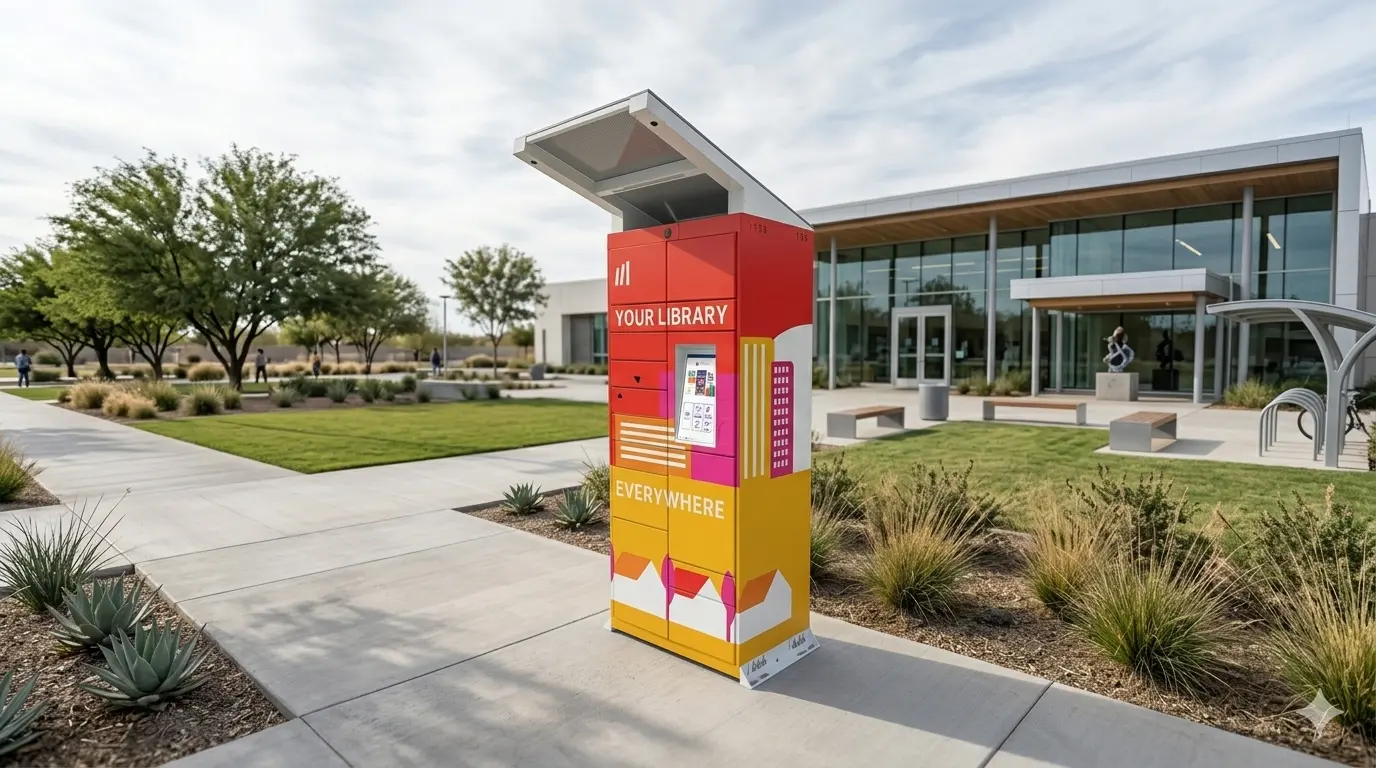
Bibliotheca Introduces remoteLocker+, a Next-Generation Locker for Library Holds Pickup
A new locker system extends library access beyond the building, enabling secure, around-the-clock pickup in a range of community locations.

Bibliotheca to Showcase Library Technology Solutions at PLA 2026
Visitors can explore self-service, automation, and access solutions, including remoteLocker+, the Romi mobile library robot, and more.