

By Vinicius Flores, PhD
Marketing Communications Manager · PhD in Communication
Introduction
Over the past three years, libraries across the globe have explored or deployed AI in cataloging, discovery, and patron support. Adoption is broad, but implementation varies significantly. To understand where AI fits, it helps to understand what came before it.
Library automation did not begin with machine learning. It began with punch cards, barcode readers, and electromagnetic security systems. The technology evolved across decades. The institutional purpose stayed the same.
This article traces that trajectory, from the MARC project and early self-check systems to generative AI and operational analytics. It examines global deployment data on current adoption and analyzes how AI is reshaping user experience and professional roles.
Drawing on published research and global survey data representing more than 2,000 librarians across 109 countries, along with implementation experience across public, academic, and special libraries, this article examines what is at stake when AI enters the library environment.
Throughout this article, “AI” refers broadly to machine learning and generative systems. Where relevant, distinctions are made between rule-based automation, statistical modeling, and generative AI.
Historical Foundations
Library technology evolved along two parallel tracks that gradually converged: software systems that organize and retrieve information, and hardware systems that manage circulation, security, and physical access. Understanding both trajectories clarifies what artificial intelligence represents today.
Software Automation
Library data automation began in the early 1960s, when universities experimented with mainframe computers, punch cards, and magnetic tapes to standardize catalog records. The MARC Pilot Project, launched by the Library of Congress in 1966, marked a turning point. Bibliographic data became machine-readable and transferable across institutions. In 1971, OCLC operationalized cooperative cataloging, reducing redundant descriptive labor across libraries (NISO, 2012; Rosenheck, 1997).
Throughout the 1970s and 1980s, integrated library systems formalized circulation, acquisitions, and catalog management (Breeding, 2009). The 1990s introduced web-based OPACs and remote access (Borgman, 1996). The 2000s expanded digital collections and incorporated advances in natural language processing into information retrieval systems (Manning et al., 2008). By the 2010s, discovery layers embedded relevance ranking and federated search as standard expectations (Breeding, 2015).
It is worth separating algorithmic retrieval from generative AI. Relevance ranking and NLP-based retrieval improved discovery for decades, but they did not generate new answers or narratives; they optimized how existing records were found.
The introduction of generative AI systems after 2022 represents a qualitative shift. Systems such as GPT-4 demonstrated the ability to synthesize, summarize, and generate text at scale, producing responses that interpret and contextualize information rather than simply retrieving it.
Hardware Automation
While software automation evolved behind the scenes, a parallel transformation reshaped the physical experience of the library.
In 1970, the Saint Paul Public Library implemented the first Tattle-Tape electromagnetic security system, developed by 3M. By the early 1990s, the technology protected collections in more than 40 countries (Breeding, 2015; Bibliotheca, 2001). In 1972, Kentish Town Library adopted one of the earliest barcode identification systems, accelerating circulation workflows and reducing manual error (Tedd, 2007).
In 1992, 3M introduced the Model 5210 self-check system, institutionalizing library self-service before self-checkout became standard in retail. The pattern was consistent: libraries adopted operational automation early, typically in response to staffing constraints and growing demand.
Early computerized cataloging
Tattle-Tape
Barcode systems
OPAC
Koha (open-source ILS)
Generative AI
MARC standard
OCLC cooperative cataloging
ILS
First commercial self-check system
Machine learning in discovery
The Current Global Landscape
The Pulse of the Library 2025 report, based on responses from more than 2,000 librarians across 109 countries, offers the most comprehensive global snapshot of AI adoption in the sector (Clarivate, 2025).
Sixty-seven percent of libraries report exploring or implementing AI. Thirty-three percent indicate active implementation. Budget constraints remain the primary barrier, cited by 62 percent of respondents. More than half acknowledge that AI adoption will require substantial reskilling.
Regional variation is pronounced. Asia and Europe report higher levels of implementation maturity than the United States.
Source: Clarivate. (2025). Pulse of the Library 2025.
The User Perspective
For users, AI enters the library primarily through discovery systems, service continuity, and accessibility.
Discovery and Recommendation
Traditional catalogs require precision. Users must know what to search for. AI-enhanced systems — including advanced NLP and, more recently, generative models — interpret semantic intent and surface related materials without exact keyword matches.
Tools such as Primo Research Assistant and Alma AI Metadata Assistant apply language models and other AI techniques to enrich records and improve relevance ranking. Some rely primarily on machine learning and NLP-based automation; newer versions incorporate generative models capable of producing summaries, suggested metadata, or contextual explanations. The practical result is reduced search friction and broader contextual discovery.
Not all recommendation experiences are generative AI. Long before generative systems, libraries relied on structured metadata, controlled vocabularies, and editorial curation to power recommendation layers that already shaped what patrons saw at the moment of borrowing.
In 2023, Bibliotheca and NoveList formed an exclusive partnership that integrates curated book recommendations directly into Bibliotheca self-service systems, connecting the moment of borrowing with personalized suggestions drawn from NoveList’s editorial database.
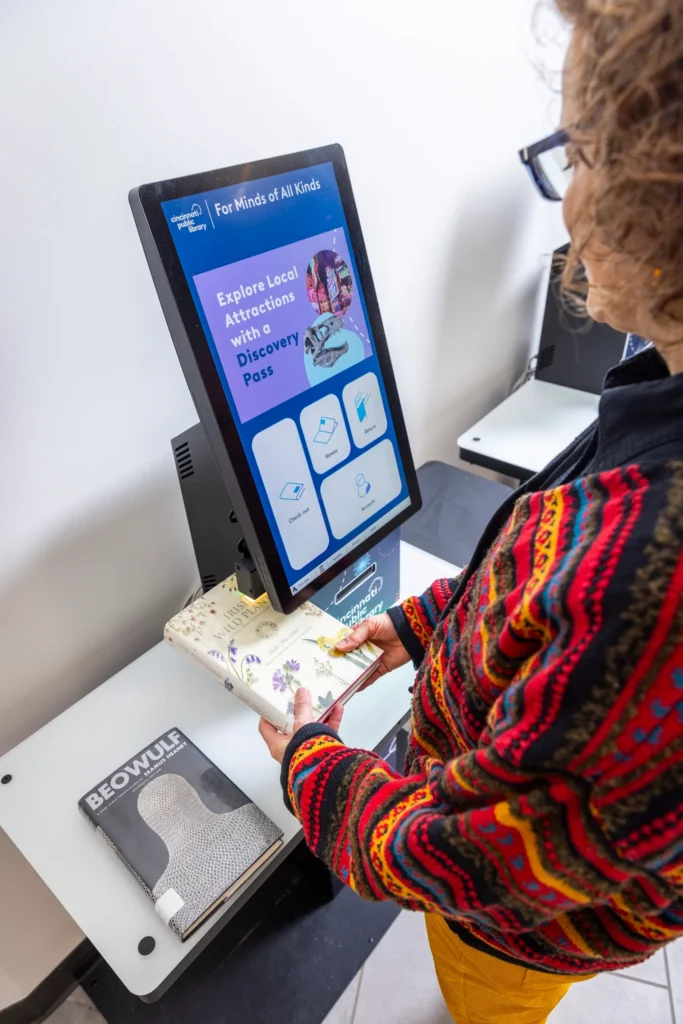
Patron uses the Bibliotheca selfCheck 3000 kiosk at Cincinnati Public Library.
Chatbots and Continuous Service
Chatbots handle frequently asked questions, renewals, reservations, and navigation guidance reliably (Aharony & Ben-Baruch, 2019; Lund & Wang, 2023). Their core advantage is availability: service continues around the clock, regardless of staffing hours.
What makes them more than a digital FAQ is scope. A systematic review by Crompton and Burke (2023) identified five distinct categories of chatbot application in academic libraries, ranging from automated feedback and user behavior prediction to intelligent tutoring adapted to individual student profiles. Together, they describe a service layer capable of supporting users from first contact with a topic through the completion of a research project.
One implementation caveat matters here. General-purpose chatbots have documented rates of factual error in bibliographic reference tasks. Libraries that build chatbots trained on their own collections and policies consistently produce more reliable results. In reference environments, a confident wrong answer is worse than no answer at all.
Accessibility as Structural Infrastructure
Some accessibility tools now incorporate AI (such as real-time translation or adaptive speech systems). Others — including adjustable hardware and high-contrast modes — rely on established accessibility engineering rather than artificial intelligence.
Text-to-speech, adaptive interfaces, real-time translation, and adjustable hardware now align with legal requirements under the European Accessibility Act and WCAG 2.1 AA standards, giving institutions both a compliance and an operational framework.
The software layer alone does not tell the full story. Physical service points shape access just as directly. Modern self-service kiosks incorporate adjustable height for wheelchair users, high-contrast display modes, integrated text-to-speech, and multilingual interfaces covering dozens of languages. Security gates are designed with wide corridors so the infrastructure meant to protect the collection does not end up restricting who can reach it.
Empirical evidence documents measurable gains in autonomy for users with visual or motor impairments when these tools are implemented (Chauhan, 2024). For populations historically underrepresented in library usage, the compliance framing tends to understate what is actually at stake.
Information Literacy
When a system can synthesize a credible-looking answer in seconds, evaluating that answer matters more than locating it.
The American Library Association defined information literacy in 1989 as the ability to recognize when information is needed and to locate, evaluate, and use it effectively. ACRL’s 2025 guidance expands that definition to include algorithmic literacy and critical engagement with generative systems.
Haider and Sundin (2019) describe how search has evolved from tools that respond to queries into “suggest engines” that anticipate needs before a query is formed. Library discovery systems are moving in the same direction.
Teaching patrons to recognize and evaluate that shift is becoming as foundational as any other form of information literacy.
The Professional Perspective
For librarians, AI represents efficiency gains, governance questions, and role evolution.
| Use Case | What It Covers | Key Drivers | Main Barriers |
|---|---|---|---|
| Automation | Routine administrative workflows; automated storage and retrieval | Operational efficiency | High infrastructure cost; integration complexity |
| Discovery | AI-enhanced and machine learning–based search; recommendation systems | Expanding access at scale | Consent ethics; difficulty converting pilots into services |
| Chatbots | Reference queries; renewals; navigation guidance | 24/7 availability; consistency | Staff resistance; privacy concerns |
| Research support | Supporting research data workflows; automated literature screening; curation; licensing | Volume and speed of scientific publishing; growth of data science in institutions | Copyright; equitable access; library role not always recognized |
| AI literacy | Training staff and users in AI evaluation and ethics | Societal AI risks; ethical mandate | Library's role not always institutionally supported |
| Analytics | Usage analysis; service planning; demand forecasting | Evidence-based service design | Technical skills; GDPR and privacy constraints |
| Technology operations | Device management; system health monitoring; AI-assisted reporting | Operational visibility across branches and service points — e.g., via libraryConnect LINK | Integration complexity; staffing constraints |
Adapted from Cox & Mazumdar (2024) and Kautonen & Gasparini (2024).
Automated Metadata and Cataloging
Cataloging has historically been one of the most labor-intensive functions in a library. AI-assisted and machine learning–based tools now generate enriched metadata and identify relationships between materials in a fraction of the time it once required.
Efficiency gains are real, but professional skepticism runs alongside them. Survey data from Clarivate (2025) indicates that cataloging professionals express the highest levels of concern about AI adoption among all library roles, with 35% reporting negative outlook. The tools are advancing faster than the profession’s confidence in them.
Predictive Collection Development
Machine learning systems analyze circulation data, unmet demand, and usage trends to inform acquisition and deselection decisions. These systems rely on statistical modeling and predictive analytics rather than generative AI.
Human judgment remains central to the process, but the inputs have changed considerably. Collection decisions that once relied primarily on professional experience and limited usage reports now draw on large-scale data analysis and trend modeling across much broader datasets.
Operational Intelligence
Large library systems manage hundreds of service points and devices across branches. Monitoring performance and generating reports has traditionally consumed significant staff time with limited visibility across locations.
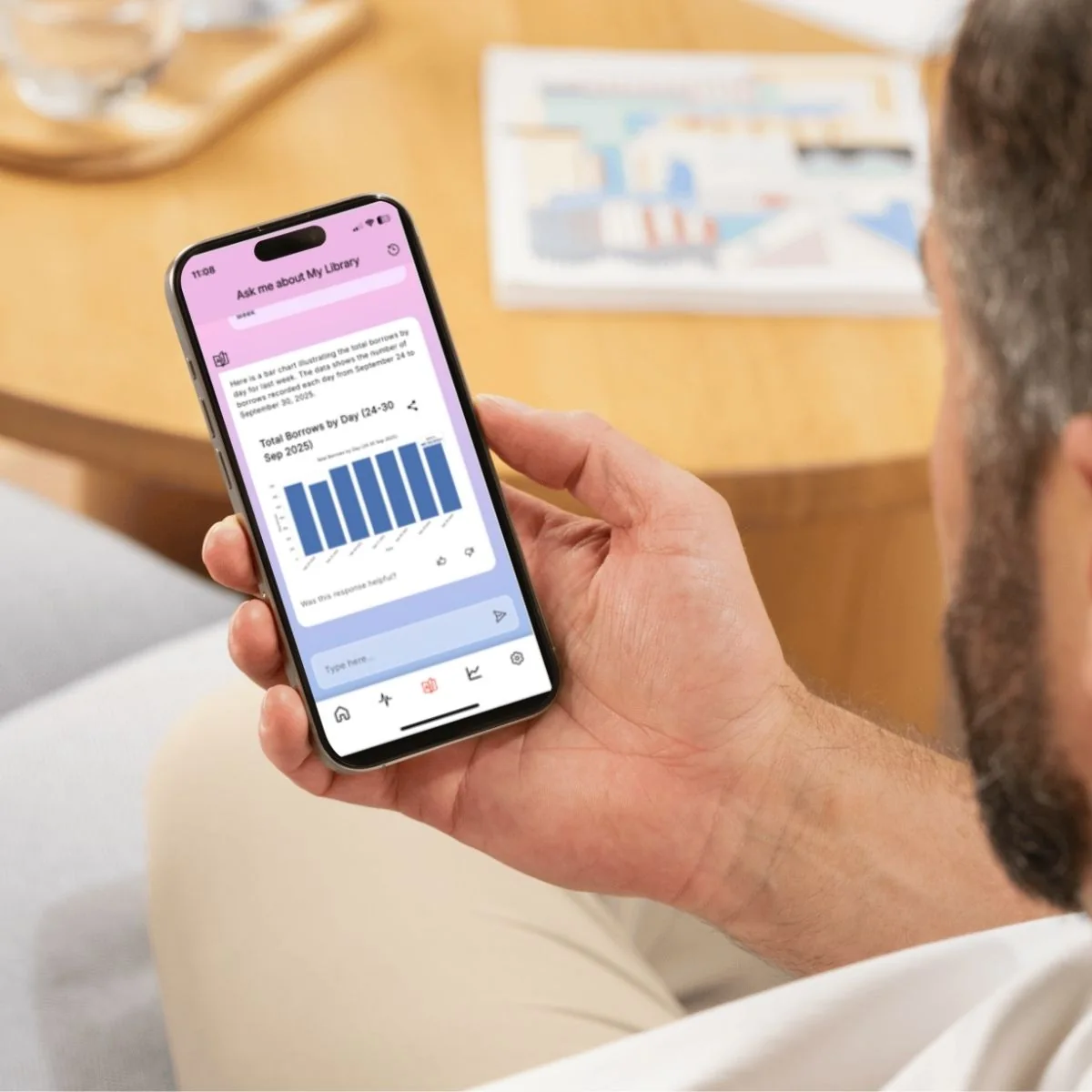
Natural-language query interfaces — often AI-assisted — layered over analytics platforms now allow staff to query operational data in plain language and generate dashboards without technical support. Tools such as libraryConnect LINK surface usage patterns and comparative performance insights directly from live system data, giving administrators a clearer picture of operations without adding reporting overhead.

With libraryConnect LINK, librarians ask in plain language and get instant visual dashboards on usage and performance.
Role Reconfiguration
Automation and AI increasingly absorb routine tasks while increasing demand for strategic, ethical, and relational work (Cox, 2023; ACRL, 2025). Frequently asked questions, basic renewals, and metadata generation are increasingly automated. Contextual curation, ethical mediation, and digital literacy instruction become more central to the profession.
The transition, however, is not uniform. A study of academic librarians across four Arab countries found that leadership style predicts AI adoption more reliably than technical training (Shal, Ghamrawi & Naccache, 2024). Transformational leadership, characterized by vision, openness to innovation, and team motivation, significantly influenced how staff perceived both the usefulness and usability of AI tools. Transactional leadership showed no measurable effect.
The model explained over 94 percent of the variance in staff receptivity. The implication is structural. Institutions seeking successful AI implementation must invest not only in technical training, but in leadership capacity. Tools can be introduced quickly. Cultural readiness develops more slowly.
The role does not disappear. It shifts. How far and how effectively it shifts depends on institutional leadership.
AI Literacy as a Professional Competency
The Pulse of the Library 2025 report reinforces this pattern. Among libraries where AI literacy is part of formal training or onboarding, 28 percent are already in moderate or active implementation — compared to just 8 percent where there is little to no institutional focus. The relationship between structured capacity building and adoption appears consistent across institution types.
The ACRL AI Competencies for Academic Library Workers, approved in October 2025, codifies this shift at the professional level. The framework outlines four areas of competence: ethics, knowledge, evaluation, and application. AI literacy is framed not as an additional technical skill, but as a reorientation of how information professionals engage with knowledge systems.
Research by Kautonen and Gasparini (2024) highlights a recurring structural gap. Many libraries assign AI competency to a single operational unit or draft policies without embedding them in practice. Their study of Scandinavian library professionals found that holistic approaches — combining foundational orientation, hands-on experimentation, and cross-departmental exchange — consistently outperform siloed training models. In one case, staff workshops led directly to the development of an AI course for library users.
Access to tools is rarely what holds libraries back. What limits AI adoption more consistently is the absence of institutional structures — time, permission, and cross-departmental support — that allow staff to experiment, make mistakes, and build real judgment about when and how to use these systems.

As AI handles routine tasks, librarians focus on strategy, ethics, and digital literacy.
What’s Next
The next phase of AI in libraries is taking shape around three distinct roles: libraries as educators helping patrons navigate AI critically, as personalization platforms that anticipate patron needs, and as active partners in the research process. Each represents a meaningful shift in how libraries define their value.
Libraries as AI Educators
If there is one emerging role that distinguishes the library from any other access point, it is teaching people how to engage with AI critically. Commercial platforms have an interest in users who trust without questioning. Libraries have a historical mandate to do the opposite.
Guides on using generative AI responsibly, workshops on detecting AI-generated misinformation, courses on evaluating synthetic sources — these are the new forms of information literacy that libraries are developing. The University of Leeds, for example, launched a comprehensive digital transformation initiative aligned with its Knowledge for All 2030 vision, with digital and AI literacy as a core strategic priority.
Personalization at Scale
The idea of a library that anticipates what a patron wants to read next, adapts how information is presented to individual learning styles, and surfaces materials before the user knows to ask — is technically within reach.
The tension is straightforward. Deep personalization requires deep data. And detailed data on reading habits is precisely what libraries have historically refused to collect. How institutions balance personalization against privacy will be one of the defining questions of the next decade.
AI as a Research Partner
In academic and research libraries, AI is becoming embedded in the scientific process itself. Automated literature reviews, research gap identification, trend analysis across large publication sets, and methodology suggestions based on historical patterns are increasingly part of how researchers work.
The academic librarian’s role, in this context, shifts toward methodological partnership — understanding not only where information lives, but how algorithms shape what researchers find, what questions they think to ask, and which perspectives get amplified or ignored.

Libraries like the New York Public Library are integrating AI literacy into workshops and digital education initiatives.
Conclusion
Artificial intelligence did not arrive in libraries as an external disruption. It emerged from a decades-long trajectory of progressive automation, each phase expanding what systems could do and raising new questions about what institutions should do.
What distinguishes the current phase is scale and interpretive capacity. AI and advanced algorithmic systems now shape how information is discovered, accessed, and evaluated. For users, that often means faster and more accessible services. For professionals, it means less time on repetitive workflows and more on judgment-intensive work.
As AI systems become more capable, the demand for human oversight and contextual expertise grows alongside them. Libraries that started with a clear problem to solve — reducing cataloging time, extending service hours, improving discovery — are advancing more deliberately than those that started with the technology.
With more than 100 countries already in some stage of AI adoption, the field is no longer debating whether to engage. The work now is building the institutional capacity to do it well.
Key References
The field has developed a core set of documents that any library professional working with AI should know. The following are organized by area.
Ethics and Institutional Positioning
ACRL — AI Competencies for Academic Library Workers (2025)
A competency framework defining what library workers need to know about AI, from basic use to critical evaluation and advocacy. Approved by the ACRL Board of Directors in October 2025.
ARL — Guiding Principles for Artificial Intelligence (2024)
Orienting principles for research libraries in the United States. Covers governance, algorithmic equity, and the librarian’s role as a responsible mediator.
IFLA — Statement on Libraries and Artificial Intelligence (2020)
The foundational ethical document for libraries engaging with AI. Defines principles of intellectual freedom, privacy, equity, and transparency. A necessary starting point for any internal policy.
Discovery, Search, and Operational Intelligence
Bibliotheca — libraryConnect LINK (AI-based Insights)
AI-based operational intelligence integrated into LINK. Staff can ask natural-language questions about device and usage data and receive visual dashboards and comparative reports, supporting evidence-based planning and system oversight.
EBSCO — AI Insights: Library Research Platforms
Findings from EBSCO’s AI pilot program, including data on natural language search, per-document summaries, and research efficiency.
Ex Libris — Primo Research Assistant
A generative AI assistant integrated into Primo. A concrete example of how AI can be embedded in discovery tools already in use at academic libraries.
NISO ODI — Generative AI and Web-Scale Discovery (2025)
Examines the tensions and expectations that generative AI creates in discovery systems. NISO positions the current moment as comparable in disruption to the arrival of web-scale discovery in 2010.
Implementation
ALA — Creating Generative AI Policies: A Guide for Public and Academic Libraries
A practical guide for developing generative AI policies. Covers scope of use, data privacy, user communication, and review processes.
OCLC / University of Calgary — Implementing an AI Reference Chatbot (Hanging Together, 2024)
One of the most detailed available accounts of implementing a reference chatbot in an academic library. Covers lessons learned, escalation protocols, and how to measure success.
PCC (Library of Congress) — Task Group on AI and Machine Learning for Cataloging and Metadata — Final Report
The official report on how AI and machine learning are being integrated into cataloging and metadata processes in the United States. Institutional and standardization perspective.
References
Aharony, N., & Ben-Baruch, G. (2019). Chatbots in academic libraries: An exploratory study. Journal of Academic Librarianship, 45(6), 102113.
Association of College and Research Libraries. (2025). AI competencies for academic library workers.
Bibliotheca. (2001). The Tattler (Winter 2001).
Borgman, C. L. (1996). Why are online catalogs still hard to use? Journal of the American Society for Information Science.
Breeding, M. (2009). Next-generation library catalogs.
Breeding, M. (2015). Library services platforms.
Chauhan, S. P. S. (2024). Enhancing accessibility in special libraries.
Clarivate. (2025). Pulse of the Library 2025 report.
Cox, A. M. (2023). How libraries can respond to generative AI.
Cox, A. M., & Mazumdar, S. (2024). Defining artificial intelligence for librarians. Journal of Librarianship and Information Science, 56(2), 330–340.
Crompton, H., & Burke, D. (2023). Artificial intelligence in higher education: The state of the field. International Journal of Educational Technology in Higher Education, 20(1).
Haider, J., & Sundin, O. (2019). Invisible search and online search engines: The ubiquity of search in everyday life. Routledge.
Kautonen, H., & Gasparini, A. A. (2024). B-Wheel: Building AI competences in academic libraries. Journal of Academic Librarianship, 50(3).
Lund, B. D., & Wang, T. (2023). Chatting about ChatGPT.
Manning, C. D., Raghavan, P., & Schütze, H. (2008). Introduction to information retrieval.
National Information Standards Organization. (2012). 50 years of MARC.
Rosenheck, J. (1997). The development of the Online Computer Library Center.
Shal, T., Ghamrawi, N., & Naccache, H. (2024). Leadership styles and AI acceptance in academic libraries in higher education. The Journal of Academic Librarianship, 50(2), Article 102849.
Tedd, L. A. (2007). The use of barcodes in libraries.
Spread the Word

You may also Like
Insights + Trends
libraryConnect LINK: Managing Devices, Data and Support in One Place
See how libraryConnect LINK gives library teams a clearer way to monitor equipment, manage changes, troubleshoot issues, and use operational data.
RFID in Libraries: What It Is and What It Changes
Learn what RFID tags contain, what it takes to convert a collection, and what libraries should consider for checkout, security, and inventory.

Customer Training | Bibliotheca Academy: Unlocking the Full Potential of your Bibliotheca Products
Discover Bibliotheca Academy, our new Learning Management System designed to help library teams access training, build product knowledge, and get more from their Bibliotheca solutions.