

By Vinicius Flores, PhD
Marketing Communications Manager · PhD in Communication
Communities defend the freedom to read best when they organize before a crisis arrives. That was the argument at the center of a recent Bibliotheca webinar on the pressures now bearing down on libraries. The audience made the case before the panel did.
Moderator Lisa Stamm, who spent 16 years in public libraries before joining Bibliotheca’s Solution Consulting team, opened with two live polls. She asked attendees what their library was facing, offering a list that included budget cuts, book challenges, and harassment. Forty-four percent chose “two or more.” She then asked about censorship, and an overwhelming majority said they had either faced it or felt pressure to censor their own collections.
Those answers set the terms for the discussion that followed. Stamm was joined by Tasslyn Magnusson, senior advisor, and McKenna Samson, program manager, both of PEN America’s Freedom to Read program, and by Laney Hawes, a Texas parent who co-founded the Texas Freedom to Read Project.
What Libraries Are Facing
PEN America has documented nearly 23,000 book bans in public schools since 2021. Its Freedom to Read team has also run needs-assessment meetings with public library leaders around the country. Samson described what came back. Staff are “afraid, confused, overwhelmed.” They face budget cuts and funding sources under attack at the local level and the federal one. Many feel undereducated in the principles of intellectual freedom, even as censorship becomes normalized.
The threats reach beyond books. Samson pointed to First Amendment audits, in which someone enters a library, claims a right to film, and waits for a reaction worth posting. She mentioned bomb threats. In Texas, there were reports of protesters standing outside a public librarian’s home. “A lot of these attacks are targeted,” she said. “They’re becoming more and more personal.”
Something quieter runs underneath all of it. Staff who find the reporting process useless or unsafe begin avoiding the titles most likely to draw a complaint, which makes the work of the censor easier than it has any right to be. Hawes has a name for the version that happens at the shelf, when a librarian pulls a challenged book rather than run it through the process. She calls it silent censorship. “We never see it. We never even know it left.”
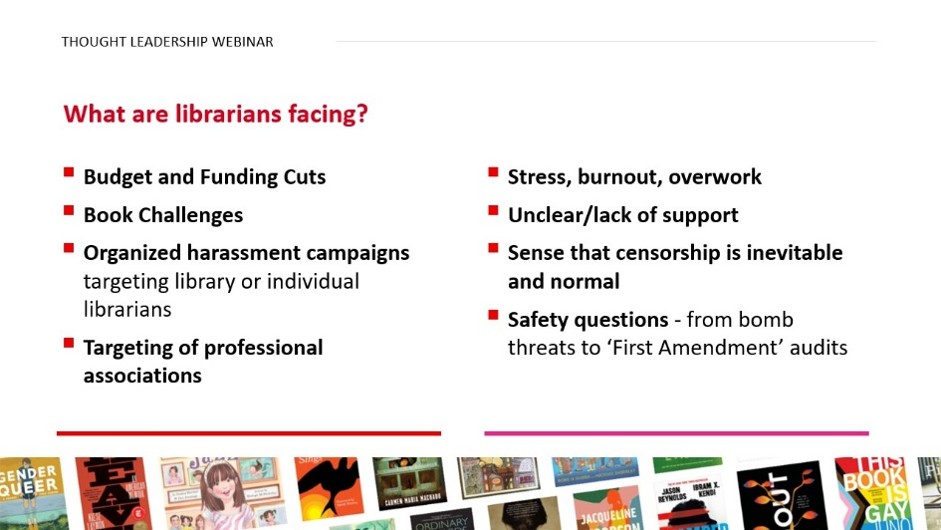
Book challenges are often one part of a wider set of pressures, from funding threats to personal harassment.
Why Local Support Matters Most
Outside groups can help. PEN America runs workshops on doxxing defense, social media strategy, and response protocols. It maintains an online harassment field manual and offers individual consultations. State and national organizations share resources. Still, the panel kept returning to a single point: the help that decides the outcome comes from inside the community.
Hawes put it plainly. “No one else is going to save your library.” The ACLU cannot save it. The American Library Association cannot save it. National groups can guide and train, she said, but they cannot stand in for the people who live there. When funding goes to a vote or a challenge reaches a board, local voices carry the weight.
She draws a line between two roles. Librarians advocate for their collections and their patrons. Parents and neighbors can speak in public ways that library staff, as public employees, often cannot. The library holds the knowledge. The people around it hold the standing to act on what they know.
How One Parent Became an Organizer
The clearest illustration came from Hawes’s own experience.
She has four children in the Keller Independent School District in Texas. Her involvement started after COVID, when a teacher friend worried about losing access to online resources. Hawes began asking questions. What looked at first like ordinary concern over age-appropriate material turned out to be something organized. A coordinated effort, backed by political action committees including the cell phone provider Patriot Mobile, was running candidates for school board and using books as the issue that would win them seats.
Almost overnight, 41 books were challenged in her district. Ten of them were not even in the collection, which said plenty about where the list had come from. The district asked for volunteers, and Hawes served on two review committees. Every title actually on the shelves, all 31, was retained. The policies were followed and they worked.
Then the board changed hands. Three new trustees took a majority, overturned the committees’ decisions, rewrote the acquisition and reconsideration policies, and replaced deliberation with a rubric. The books came back off the shelves to be run through it.
That was the turning point. “I realized no one’s going to fix this for my community,” Hawes said. She found other Texas parents facing the same titles and the same tactics. With Anne Russey near Houston and Frank Strong in Austin, she co-founded the Texas Freedom to Read Project, modeled on the earlier Florida Freedom to Read Project. The group exists to teach parents and citizens how to do this work in their own towns, precisely because the founders cannot do it for them. Residents have to attend the library board meetings, the school board meetings, and the city council meetings themselves.
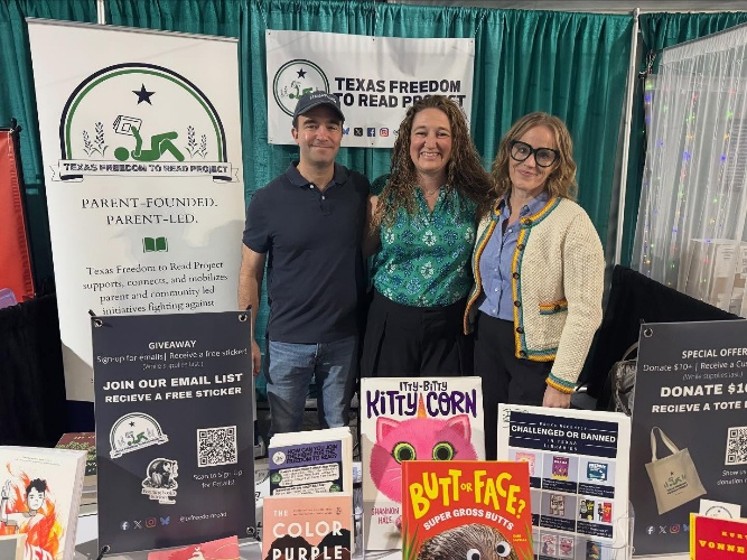
What began as one parent’s questions grew into a statewide network for protecting the freedom to read. Photo courtesy of the Texas Freedom to Read Project.
Build the Community Before You Need It
Hawes’s strongest advice concerns timing. Relationships formed during a crisis are formed too late.
She encourages librarians to know who would show up if a challenge came. Join the local Facebook groups and Instagram accounts where residents talk about municipal politics, even as a quiet observer. Notice who speaks well of libraries. Those are the people to invite onto a board or a friends group later. It takes only two or three determined people to wreck a library, she points out, because of how hard they are willing to work. The same arithmetic runs in the other direction.
Magnusson offered a way in. She had picked it up from organizers at Let Utah Read, who open conversations by asking someone to name a book they loved as a child, then to imagine being told that book had to go. The question tends to land somewhere an argument about policy never reaches.
Know Your Policies, and Follow Them
For librarians, the panel’s first practical step had nothing to do with recruiting anyone. It had to do with policy.
Hawes asked librarians to know their acquisition, reconsideration, challenge, and weeding procedures, and to follow them. Keep impeccable records. When a complaint arrives, take a breath, read the policy, and run the book through the documented process. When a supervisor asks for something outside it, such as pulling every LGBTQ+ title, point to the procedure and ask for direction in writing. Requests like that tend to arrive in conversation, never on paper.
She also warned against rubrics and checklists, which the people pushing bans tend to prefer. A book should be weighed whole, in a real discussion, not scored against a form.
Documentation matters for a specific reason. In Texas, SB13 has led school districts to pull books preemptively, out of worry rather than conviction. Librarians forced to weed a title under that pressure should note the true reason in the ILS. If a challenge drove it, say so. If the statute did, name it. The record is what allows a community to see what actually happened.
No single person should absorb every challenge. Where a director evaluates each book alone and decides whether it stays, the pressure lands on one employee, who can then be harassed and exploited because everything runs through her. Committees that include parents, educators, and librarians spread the weight. “Nine times out of 10 books are saved,” Hawes said, as long as the committee is not stacked.
One library in south-central Texas impressed the panel with a simple safeguard. Its challenge committee, an odd number of people so a vote cannot tie, is drawn at random, and the drawing is recorded on video and made public. Nobody can claim the panel was rigged. When someone arrives to shout, the staff thank the person for the concern, affirm the right to challenge, and follow the procedure.

Clear policies, consistent records, and broad-based committees give libraries a steady process when challenges arrive. Photo: fizkes/iStock.
Small Groups, Real Influence
The session closed where it began, on the strength of ordinary people. Many library supporters never attend a board meeting until a challenge forces the issue. Given the opening, those same residents testify, email their representatives, and serve on committees.
Hawes pointed to state legislative sessions, where a few parents speaking for the freedom to read can shift a committee hearing. She mentioned the Texas Library Association’s bill tracker, which lets residents follow every library-related bill through the session and know when a hearing needs their voice. A reader in a state without such a tool, she suggested, might be the person to ask her state library association to build one.
Protecting the freedom to read, the panel agreed, belongs to no single organization. It rests with communities that decide to show up for their libraries.
Watch the Full Session
The full conversation, including the audience Q&A, is available to watch on demand. Fill out the form below to access the recording.
For more discussions like this one, explore additional Bibliotheca webinars on library access, service, and community support. The organizations featured in this session also offer resources for librarians and community members: PEN America’s Freedom to Read program and the Texas Freedom to Read Project at txftrp.org.
Spread the Word

You may also Like
Insights + Trends

AI for Librarians: Where to Start and 5 Real Use Cases
The skills behind a good reference interview are the same ones that make AI useful. A library director shows how, with five projects you can borrow.
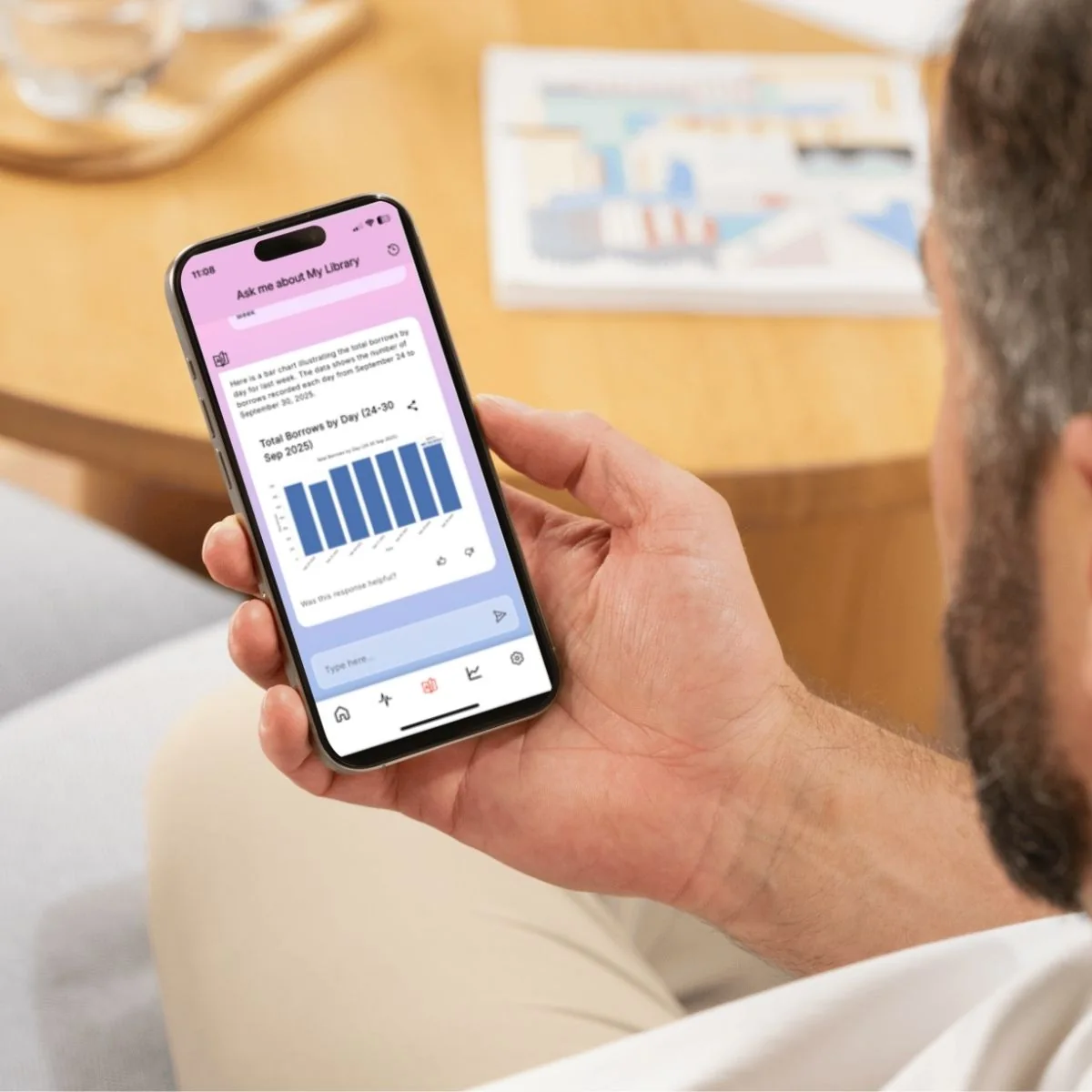
libraryConnect LINK: Managing Devices, Data and Support in One Place
See how libraryConnect LINK gives library teams a clearer way to monitor equipment, manage changes, troubleshoot issues, and use operational data.
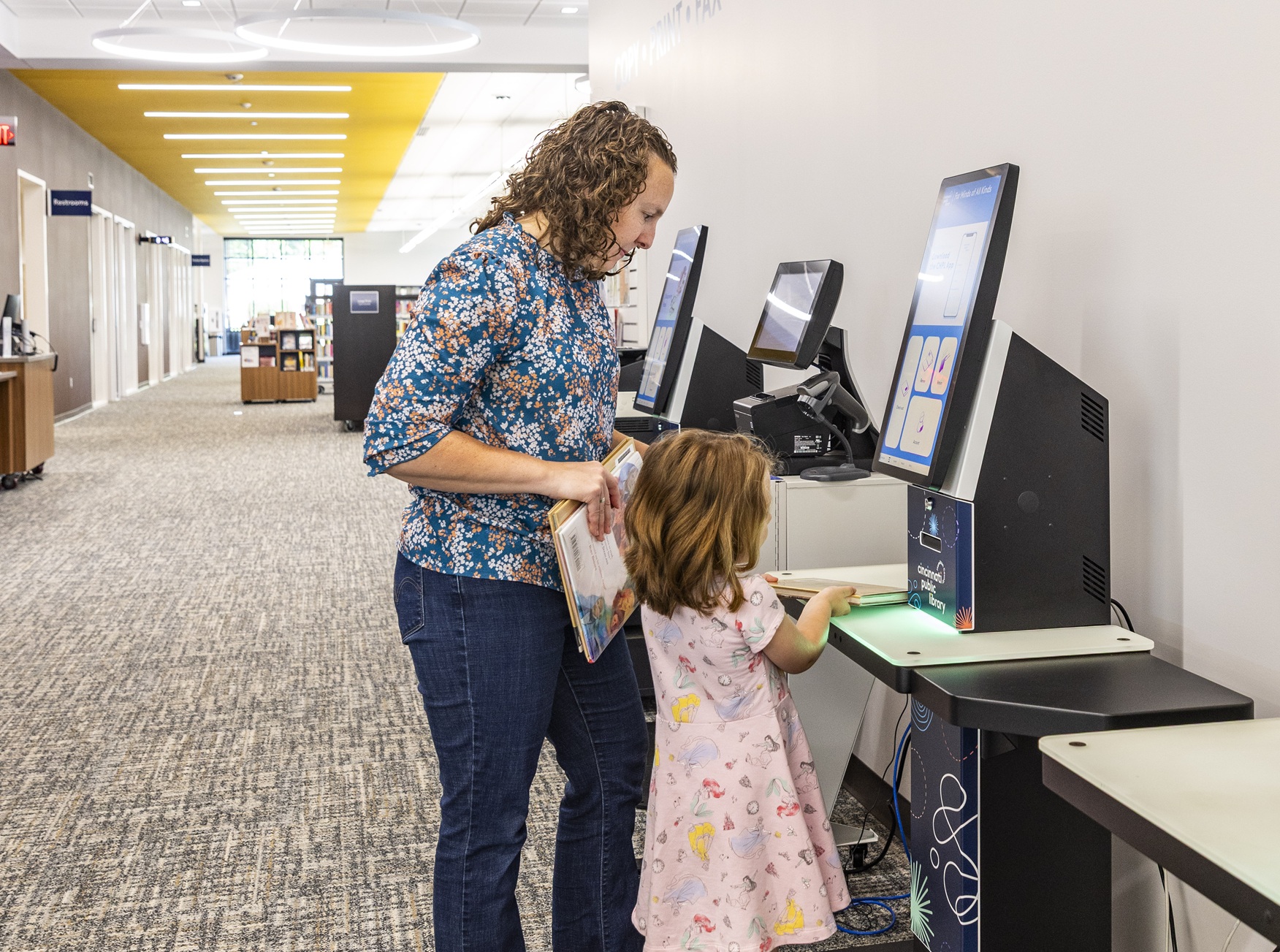
RFID in Libraries: What It Is and What It Changes
Learn what RFID tags contain, what it takes to convert a collection, and what libraries should consider for checkout, security, and inventory.