


Lower Merion Library System
Lower Merion Township, Pennsylvania
United States

Whitby Public Library
Whitby, Ontario
Canada
By Vinicius Flores, PhD
Marketing Communications Manager · PhD in Communication
Libraries writing their first AI policy run into the same questions early.
A standalone document, or language added to the policies already on the books? Board approval, or administrative sign-off? And how often does any of it need to be revisited?
Bibliotheca put those questions to two libraries that have been through it, in AI Policy in Libraries: Firsthand, Frontline Examples, a follow-up to March’s session on getting started with AI.
The session brought together Shelby Moffatt, Community Engagement Specialist at Whitby Public Library in Whitby, Ontario, and Adam Haigh, Technology Librarian at the Lower Merion Library System in suburban Philadelphia. Lisa Stamm of Bibliotheca’s Solution Consulting team moderated the discussion.
They took opposite routes.


Left: the Central Library in Whitby, Ontario, one of three locations. Right: Ludington Library in Bryn Mawr, Pennsylvania, the largest of Lower Merion’s six branches. Photos courtesy of Whitby Public Library and Lower Merion Library System.
Starting With Staff
Whitby formed an AI working group in early 2024, co-led by a reference librarian and the community engagement specialist, with oversight from a manager. Members represented the branches, the central library, systems, and borrower services.
The selection was deliberate. The library wanted people who were curious about AI and people who were cautious about it, so both positions had a voice in the room.
The group set out to build comfort, confidence, and capacity internally before engaging the public.
What the Survey Found
That work started with a staff survey in the winter of 2025. It drew 46 responses from a frontline staff of about 50.
Comfort with AI averaged 4.8 out of 10, while knowledge averaged 5.3. Just under a third of respondents said they had used AI at work.
Those who had used it mainly did so to edit or draft emails and reports, brainstorm program ideas and titles, and summarize long documents.
Among those who had not, the main barriers were lack of knowledge and confidence, ethical and privacy concerns, and environmental impact.
When asked what would help, staff pointed to general information about AI and its role in libraries, guidance on ethical use, and training.
Whitby built the sequence around those needs: policy first, training second, and public programming after that.

The survey asked staff to rate their comfort and knowledge from one to ten, to say whether they used AI at work, and to name what was stopping them.
A Policy Built to Move
Whitby’s document is an administrative policy. It applies to all staff and volunteers, and it is approved by the CEO rather than the board, which keeps it at a level where it can be reviewed and adjusted as the technology changes.
Its principles are short. Protect privacy and data, maintain human oversight, ensure transparency and fairness, and use AI as a tool rather than a replacement for staff expertise.
The group drafted it by reading what peer libraries had already published, including Toronto Public Library’s policy, and keeping what fit. Moffatt described the result as a patchwork, and open-ended on purpose.
Training followed. Working group members completed CTRL-F’s digital media literacy course, a Canadian program built for educators and adult learners, before all staff took it between December 2025 and January 2026. A debrief survey closed the cycle. The goal was stronger critical thinking and information evaluation.
The original plan had been a patron-facing policy. It changed partway through, once the internal work turned out to come first.
Writing AI Into What Exists
Lower Merion went the other way.
The system formed its working group in September 2025: the director of libraries, the technology librarian, the adult services and reference librarian, and three at-large board members. It met roughly eight times through April, split across subcommittees on library philosophy, materials selection, internal use, and education.
It did not produce an AI policy. It produced amendments.
The revisions ran across materials selection, reference services, internet use, privacy and confidentiality, photography and videography, and security cameras. In most cases the change was a paragraph or two inside something that already existed.
Some of it is very short. The local author policy now specifies that local authors must be human. The security camera policy prohibits facial recognition.
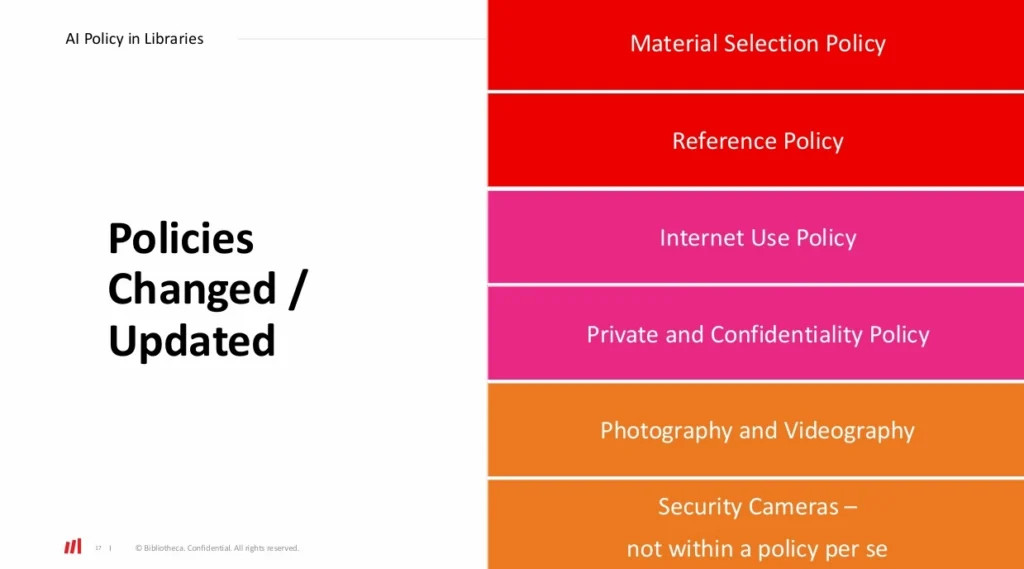
The group reviewed each policy in turn rather than drafting a new one. All of them now sit on a review cycle.
Where the Language Softened
Materials selection took the most revision.
The first version ruled out material authored, generated, or narrated by AI outright. The group pulled that back after working through what enforcement would require. Identifying AI content is getting harder, and a library’s ability to keep it out depends largely on what vendors are willing to disclose.
What the policy commits to now is reasonable effort, plus labeling. Material added on purpose gets labeled in the catalog. Material already in the collection that is identified later as AI-generated gets labeled too.
Telling Patrons What Happened
The reference services policy is new, approved in April 2026.
Staff answer patron questions from books, websites, and other vetted materials rather than AI tools. When AI is used, staff say so, and offer to verify the answer.
The internet use policy carries a related warning, and it is hard to miss. At Lower Merion it sits inside the terms and conditions patrons acknowledge every time they log into a public computer.
Policy or Guidelines
An attendee asked whether a formal policy is the right instrument at all, given how quickly the technology changes.
Both libraries had already answered it in practice. Whitby’s document is called a policy because the CEO signs it, but it functions as guidelines, deliberately open-ended. Lower Merion’s language carries policy weight because it sits inside documents the board had already approved.
Haigh’s framing was that policies are, and should be, cyclical. Most get reviewed once a year. With AI in them, every six months may be closer to right.
Their next steps cross over. Whitby expects to start adding AI language to its other policies. Lower Merion is turning to staff education.
Where to Start
Both speakers were asked what they would tell a library that has not begun.
Decide what the policy is for, then work backward. Chunk it. Leave off the firm deadlines unless something requires them. Know whether the audience is internal or external, because almost everything else follows from that.
For a library with fewer than ten staff, the advice was to start general rather than comprehensive, and to look outward for capacity. A board, a nearby college, a patron who works in the field. Whether any of that is available depends on the library’s own rules about outside partners, but the question is worth asking early.
Neither library recommends handing the drafting to AI, though Haigh noted it is useful for getting unstuck at the beginning. Someone in the Whitby group did run a prompt, to see what the tool would say. It did not shape the document.
Moffatt’s recommendation was less procedural. Play with it. The first prompt she ever typed was a question about what the tool thought of libraries.
Watch the Full Session
The recording includes both presentations in full, along with a Q&A covering staff buy-in, AI-generated images in library promotion, bias, and what to do when a staff member declines to use AI on ethical grounds.
Links shared during the session included both libraries’ policies and the American Library Association’s guidance on the use of artificial intelligence in libraries, written by a 30-member working group and built to be revised over time.
The next session, Becoming an AI Superuser in Libraries: Where to Start, What to Work On, is scheduled for September 23 with Migell Acosta, Director of San Diego County Library.
To connect with the Bibliotheca Solution Consulting team, visit: https://info.bibliotheca.com/bibliotheca-solution-consulting
Fill out the form below to get access to the recording.
Spread the Word

You may also Like
Insights + Trends

AI for Librarians: Where to Start and 5 Real Use Cases
The skills behind a good reference interview are the same ones that make AI useful. A library director shows how, with five projects you can borrow.
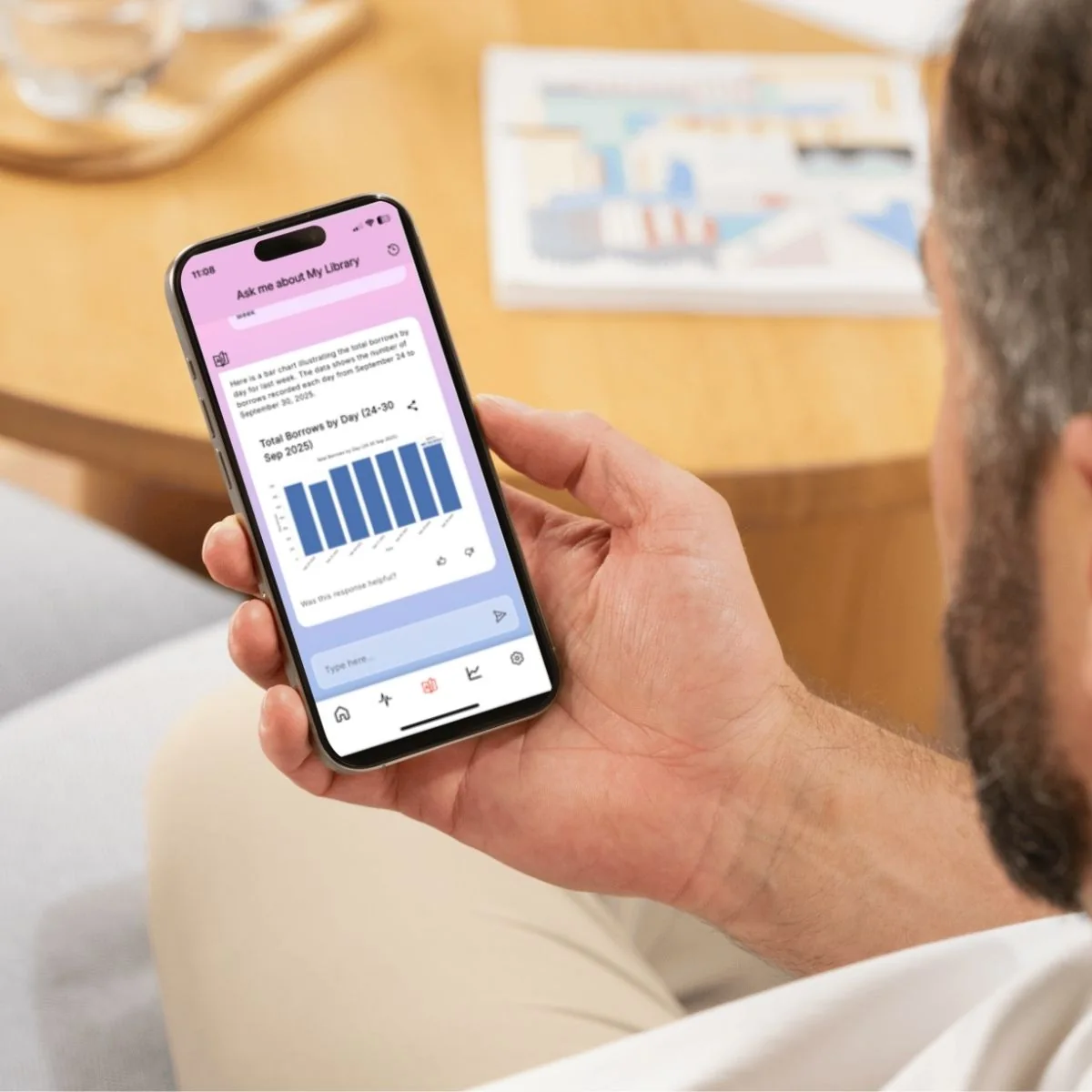
libraryConnect LINK: Managing Devices, Data and Support in One Place
See how libraryConnect LINK gives library teams a clearer way to monitor equipment, manage changes, troubleshoot issues, and use operational data.

RFID in Libraries: What It Is and What It Changes
Learn what RFID tags contain, what it takes to convert a collection, and what libraries should consider for checkout, security, and inventory.