

By Vinicius Flores, PhD
Marketing Communications Manager · PhD in Communication
Radio frequency identification (RFID) lets libraries read multiple items at once instead of scanning one barcode at a time. This guide explains how the technology works, what a conversion involves, and what changes at the desk, gates, shelves, and back room. It also covers the trade-offs to consider before you invest.
What RFID is in a library
RFID in a library has two parts: a tag inside each item and an antenna that reads it. A small chip in the tag stores information about the item, and a printed antenna lets a reader retrieve it.
Library tags are passive. They carry no battery and broadcast nothing on their own. They respond only when they come within range of a powered antenna, and library RFID operates at 13.56 MHz, the same frequency used by contactless payment cards and NFC.
During conversion, the library writes three data points to each tag: the item barcode, the item or media type, and a code identifying the home library, defined under ISO 28560 as an ISIL code. Libraries in the United States commonly use their OCLC symbol, which is accepted as ISIL compatible. The tag also carries a security bit, switched on during tagging, off at checkout, and back on at check-in.
That is the whole model. Everything else in this guide is a different reader doing something with the same tag.

An RFID tag is applied inside the back cover, the usual position for books.
A barcode must be presented to a scanner one item at a time, aligned and readable. An RFID antenna can read multiple items at once. The difference shows up in repetitive tasks such as checkout, check-in, shelf inventory, and holds.
Tattle-Tape™ uses electromagnetic security to show whether an item is secured or unsecured. It can trigger a gate alarm, but it does not identify the item. RFID combines security with item identification.
That added identification is what enables RFID to support self-service, faster inventory, automated returns, and item-level alarm information.
A library RFID tag stores information about the item, not the patron. It does not contain a name, library card number, or borrowing history.
ISO 28560 sets the rules for storing library item data on RFID tags. That common structure allows equipment from different suppliers to read the same collection. In the United States, NISO RP-6-2012 defines a common data profile for library RFID.
The tags are made to stay with an item for years. Bibliotheca asset tags have 1,024 bits of memory, support 100,000 read and write operations, and are rated for 50 years of data retention. They use ISO 15693 and ISO 18000-3.
For books, tag placement matters. The usual position is inside the back cover, with tags staggered across three locations instead of placed in the same spot in every book. If several tags line up in a stack or on a shelf, readers may have more difficulty separating one item from another.
Laptops, tablets, hotspots, and other metal items need tags made for metal surfaces.
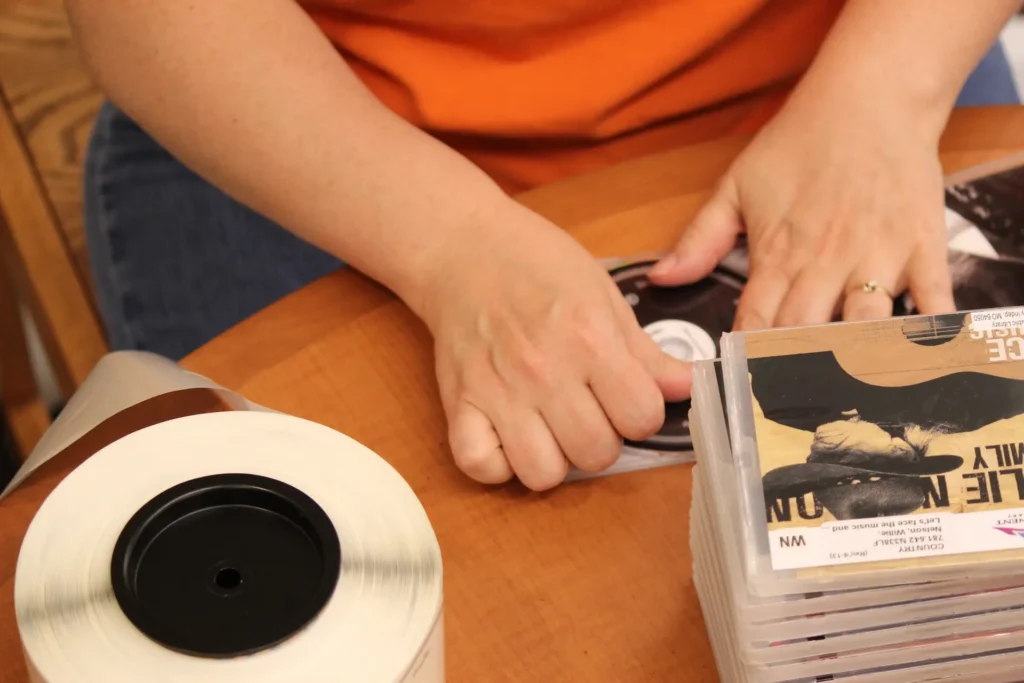
RFID tagging at Mid-Continent Public Library in Missouri, US.
What an RFID conversion involves
This is the honest part of the subject. Every item in the collection needs a tag, and every tag must be linked to the item already in the catalog. It is the most labor-intensive step, and each item goes through it once.
The work itself is simple. Conversion software is preconfigured with the library media types and home library code. Staff scan the existing barcode, place the item on an antenna, and the software writes the data and switches on the security bit. The software runs locally and does not need a live ILS connection during tagging. It reads the barcode from the scanner and writes that data to the RFID tag.
With two people working from a cart, a team can tag at least 300 items an hour. The equipment moves along the shelves, so only one item is removed at a time, and the collection remains available during conversion.
The same basic approach works at very different scales. Spanish Fork Public Library in Utah, US, converted more than 75,000 items with staff and volunteers. Blue Mountains Library in New South Wales, Australia, converted 90,000 items across six branches in about three months, training staff at each branch and moving the tagging cart from one location to the next.
Ruth Faulkner Public Library in Western Australia completed its conversion in sixteen weeks using library staff. The University of Wyoming, in the US, converted about two million items after roughly six months of planning and nine months of implementation, working with campus IT and an outside tagging vendor.
Tagging is a one-time project. The value comes from the repetitive work RFID can reduce after the conversion is complete.
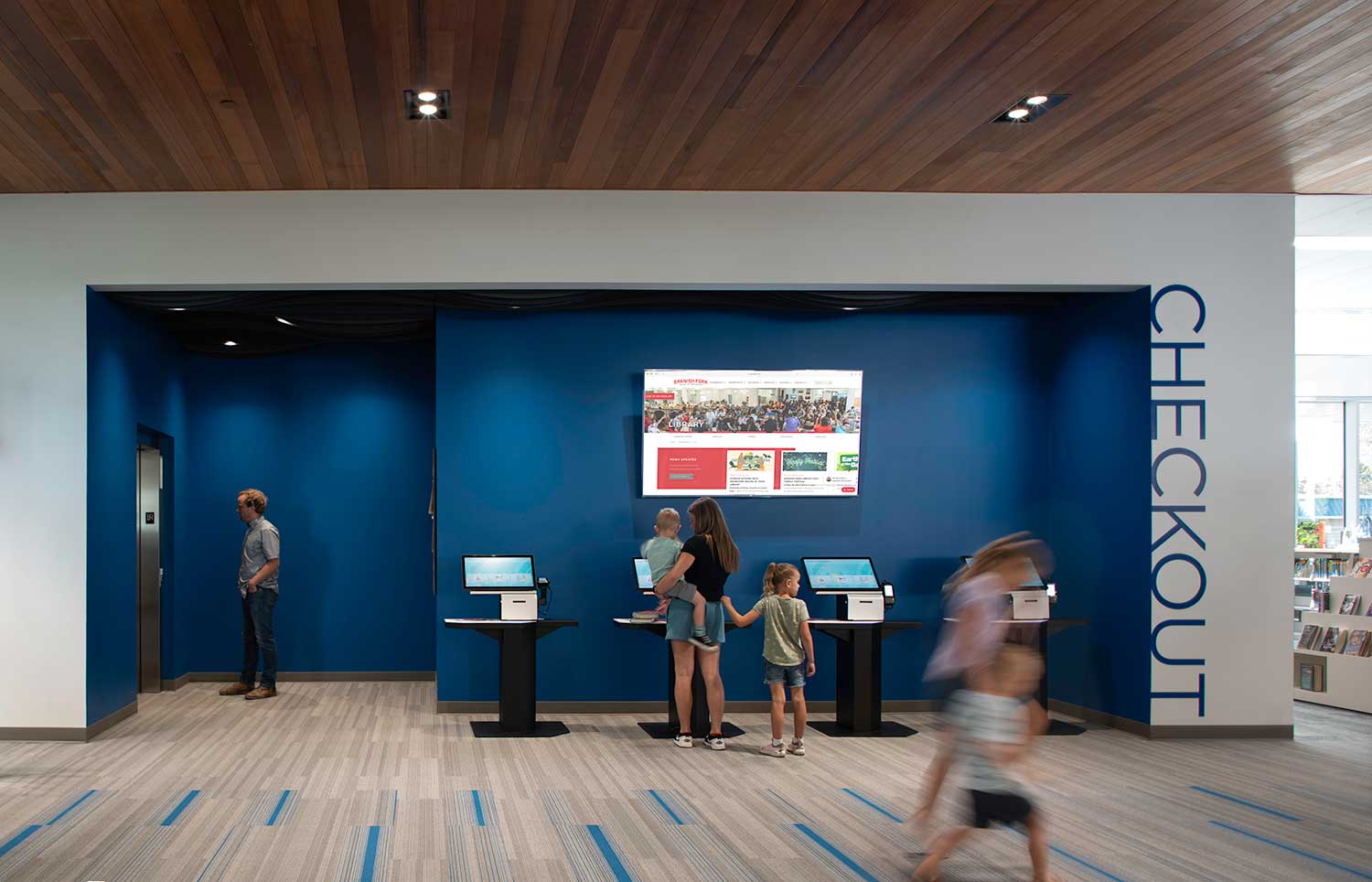


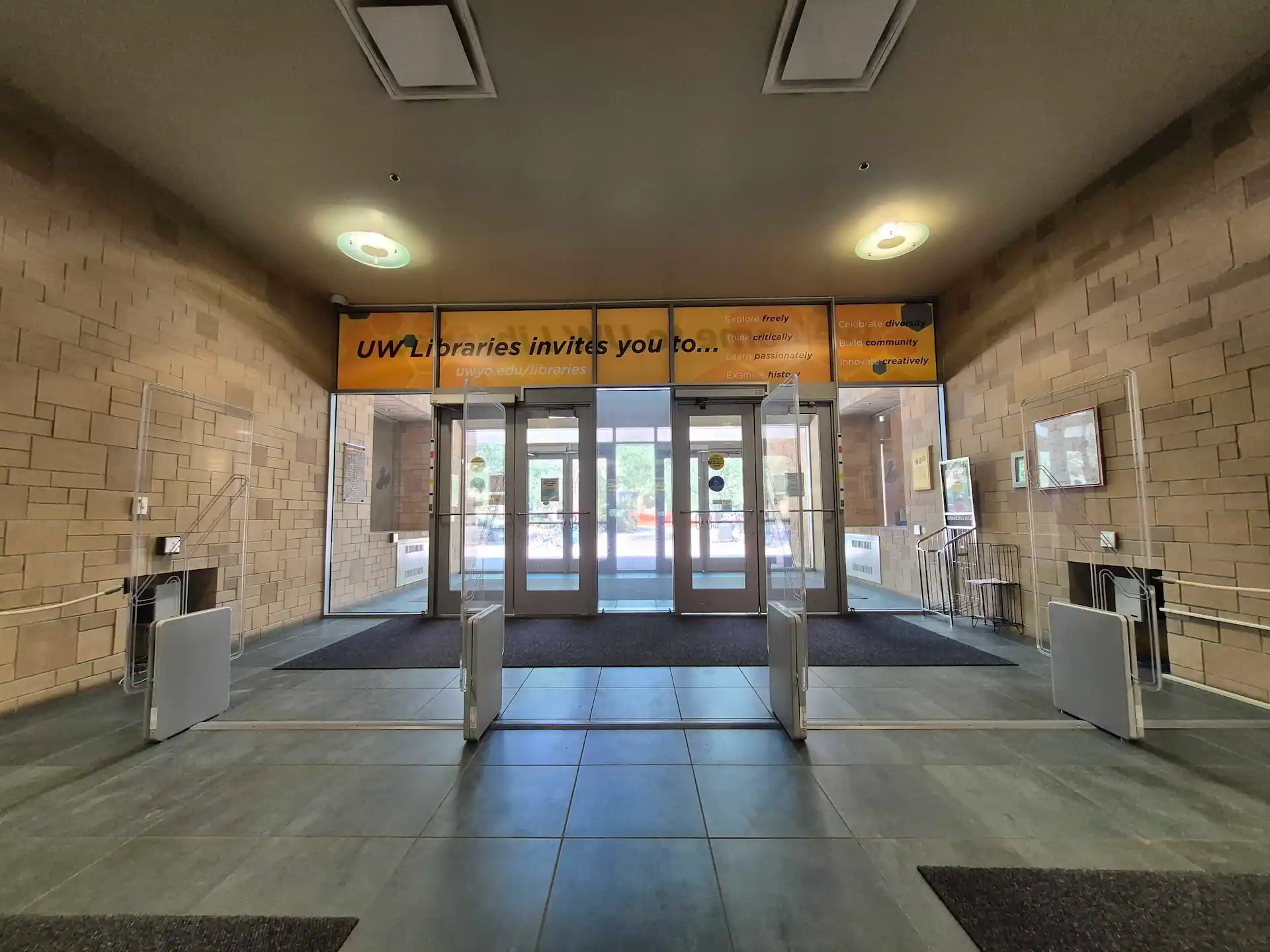
Shown here: Spanish Fork Public Library, Blue Mountains Library, Ruth Faulkner Public Library, and the University of Wyoming.
What changes at the circulation desk
Take three books. In an electromagnetic (EM) workflow, staff scan three barcodes and then desensitize three security strips: six actions for three items.
With RFID, all three items can go on the antenna together. The workstation reads the tags, sends the item data to the ILS, completes the transaction, and changes the security status in the same operation. A staff workstation can read a stack roughly 12 to 18 in (30 to 46 cm) high. In practice, the limit is often how many items staff can comfortably verify on screen at once rather than the antenna itself.
Staff still inspect returned items for damage and handle exceptions. RFID removes much of the repetitive scanning between those steps. At Park Ridge Public Library near Chicago, staff processed about 60,000 items manually each month before moving to RFID.
The same ability to read several items at once also makes self-service faster for patrons. Instead of finding and scanning each barcode, they can place multiple items in the reading area together.
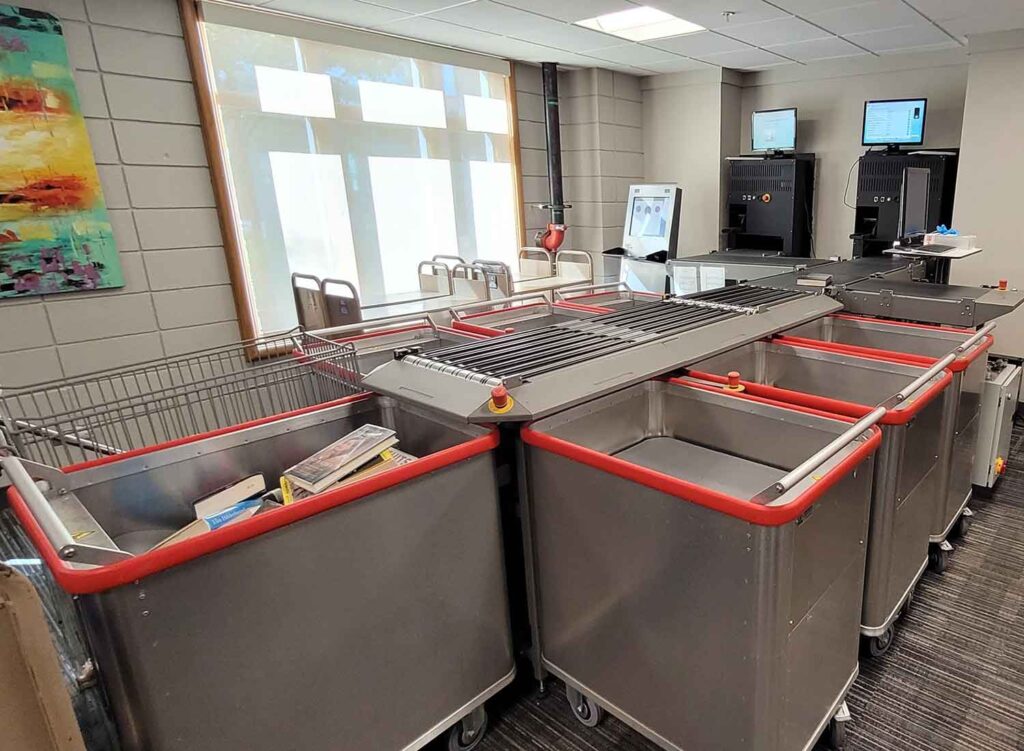
A seven-bin flexAMH sorter at Park Ridge Public Library in Illinois.
Libraries have seen substantial shifts toward self-service after adopting RFID. Spanish Fork Public Library went from about 1% of transactions at self-service kiosks to 76%, while Park Ridge reached 97%. Gatineau Public Library in Quebec passed 80% across eleven branches, and Dollard-des-Ormeaux, also in Quebec, which had not previously offered self-service, now handles all lending that way.
Athy Community Library in County Kildare, Ireland, reports 76% of lending, returns, and payments through self-service. In England, Sunderland Libraries went from about 300 self-service checkouts a month to more than 3,000 within a year of tagging its collection.
Once the collection is tagged, self-service does not have to stay inside the building. Libraries place pickup lockers where their communities already go, and the items are checked out to the borrower when the locker opens. Summit County Library in Utah put one in a town of 870 people that had never had a library of any kind, ten miles from the nearest branch.
Garland County Library in Arkansas placed four across a county of 735 square miles, and at the rural store location alone, registrations rose by 500 and circulation by more than 30%. Oakville Public Library in Ontario reports that its locker at a community center circulates more than the branch across the parking lot, because the center is open eighteen hours a day.




Shown here: Dollard-des-Ormeaux Library, Sunderland Library, Summit County Library, and Athy Community Library.
What changes at the door
A conventional alarm tells staff that something triggered the gate. It does not tell them what.
An RFID gate looks for a library tag with the security bit still on, so phones and leftover retail tags do not set it off. When it does alarm, it reads the tag that caused it, and gate software can resolve that identifier to a title on a screen near the door.
The difference is procedural rather than technical. Librarians at Gatineau Public Library used to stop a group, collect the books, and scan them one at a time to find the item. With an identified alarm, staff can ask about one specific title. Bentonville Public Library in Arkansas reported the same effect: less staff intervention, and less interruption for the person at the door.
Two cautions belong here. No gate detects every item, and the American Library Association notes that no standard national rate exists for library material loss, so any confident percentage is an extrapolation. And a gate cannot correct what happened earlier. If an item was checked out with a barcode scanner alone, circulation was updated, and the tag was not, and the gate is right to alarm.
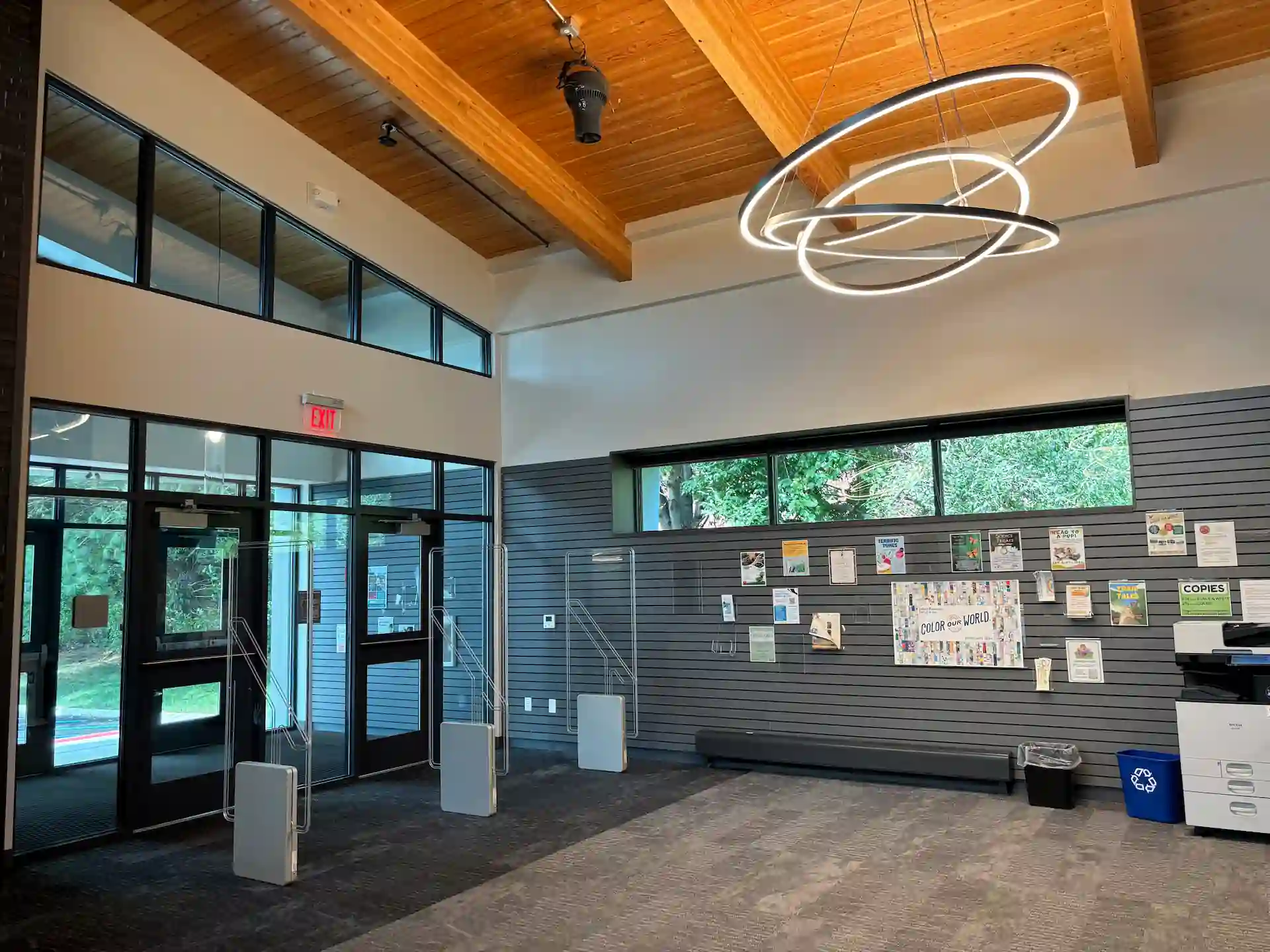


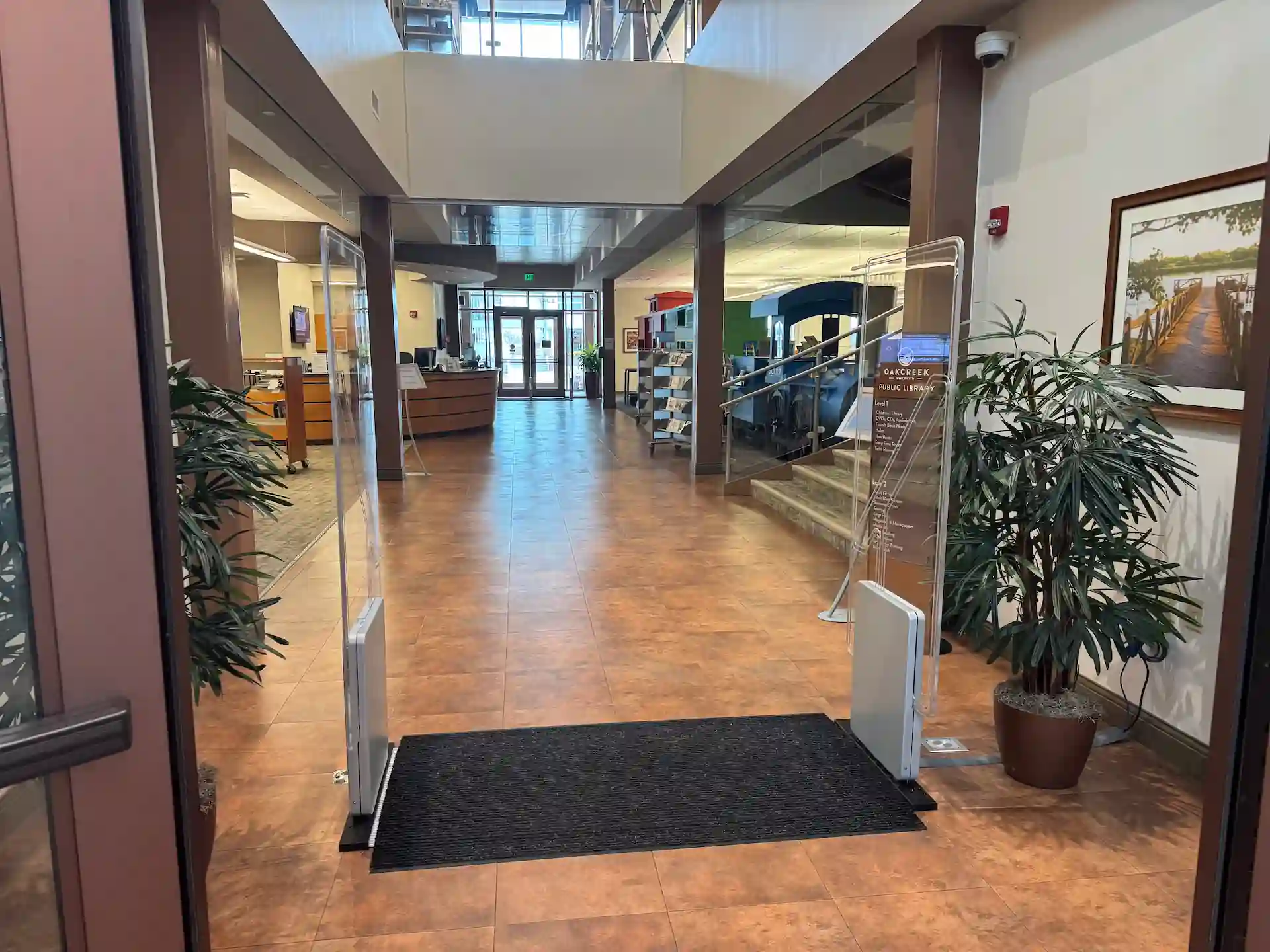
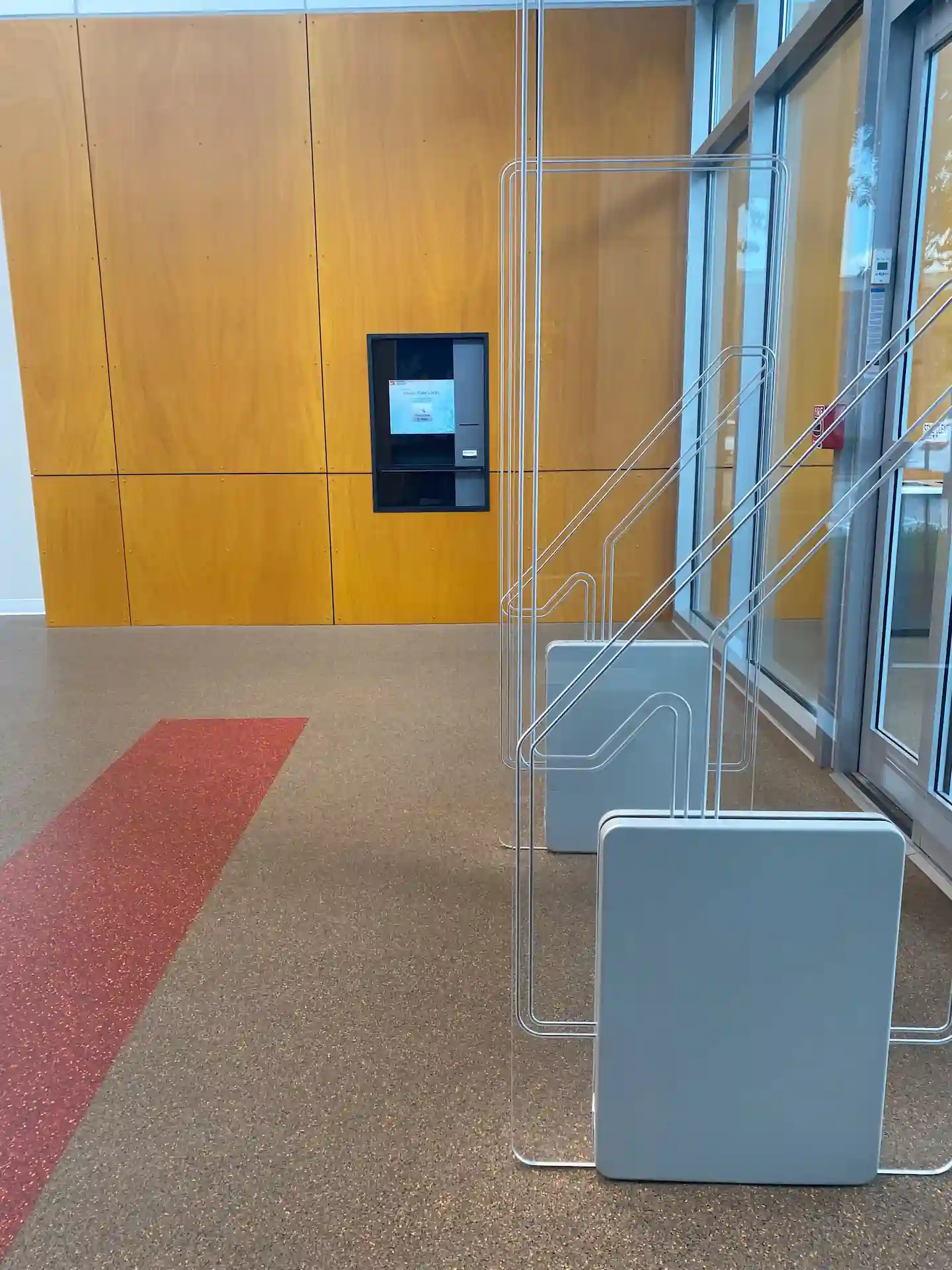
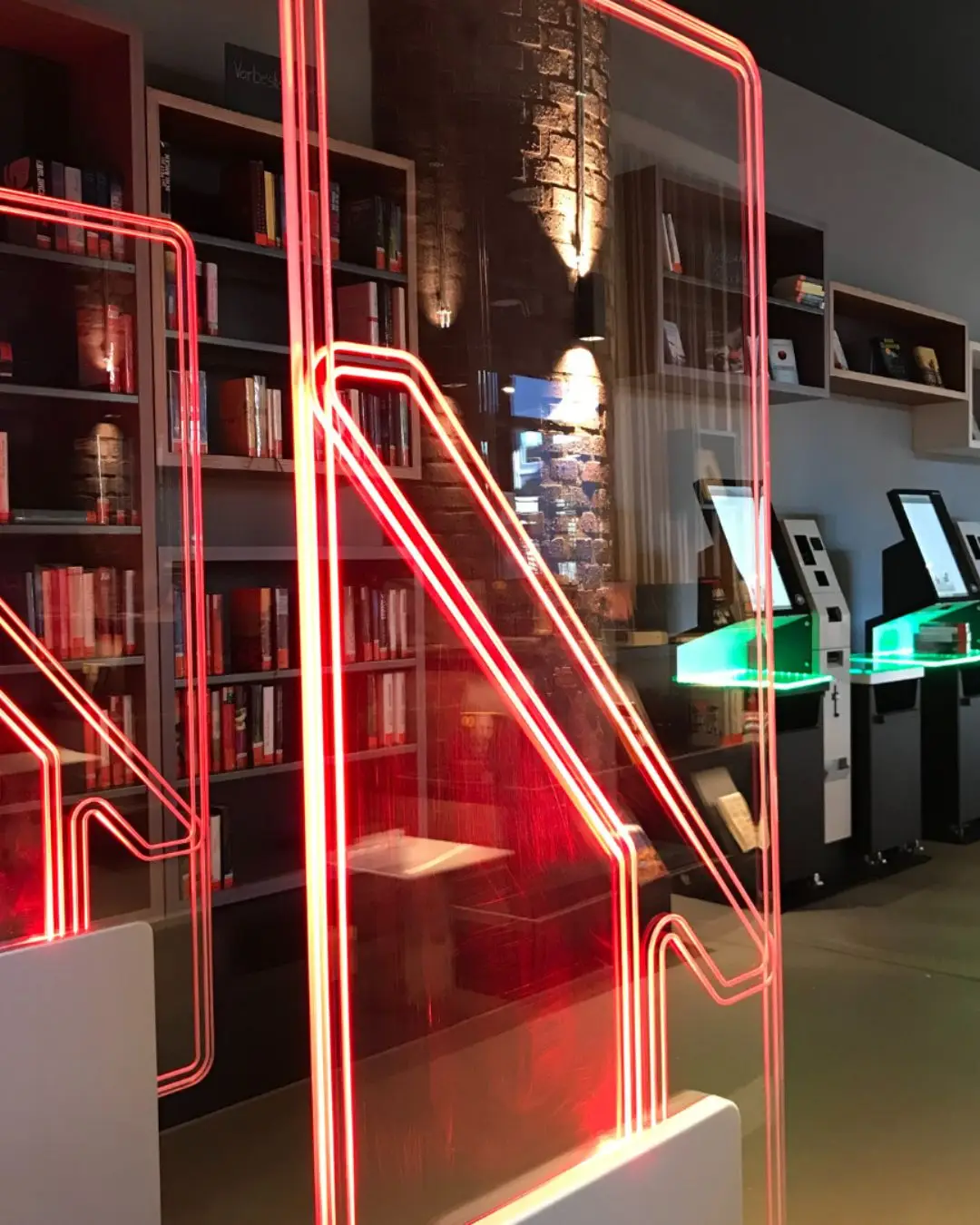
RFID security gates can be integrated into very different library environments, from open entrances and wide aisles to more architectural, design-led installations.
What changes on the shelves
Shelf work is where RFID surprises libraries that adopted it for circulation.
A handheld inventory wand reads items where they sit. In a live demonstration, two shelves holding thirty items were read in seconds, returning title, call number, barcode, and author for each one. A full collection can be covered in hours, or a day or so for a very large one.
The change is easiest to see in libraries that tried to do it the old way. Blue Mountains Library ran a stock take one branch a year, closing that branch for the day, which meant six years to cover six branches; the same libraries now count monthly. The University of Wyoming had used students and staff for its last inventory, and took about five years. Sunderland Libraries now scan a full inventory in about an hour.
Beyond counting, staff can load a list of items marked missing and walk the stacks looking for them, find items whose security bit was left off and switch it back on as the wand passes, and spot materials that are substantially out of sequence. The collected barcodes export as a plain text file for the ILS, which marks each item as inventoried on that date and shows what was not found.
It is also useful to know where a wand has limits. Because the antenna reads several nearby tags at once, it may not reliably be detected when two adjacent books have been swapped. It is better at finding larger shelving errors. Dense collections, such as sheet music, place many tags close together and usually require a slower pass with a stronger signal.

A staff member uses an RFID inventory wand to scan books on the shelves at Washington Library, part of Sunderland Libraries in England.
Returns are where identification and batch reading compound.
With tagged items, an automated materials handling system can check in each item as it arrives, identify the ones with holds, and sort the rest by branch, media type, or workflow. An RFID return shelf takes this further in a small space: patrons place returns on the shelf, the items are checked in, and they are immediately available for the next patron.
Volume is what makes the case. Frankfurt Central Library takes returns from every branch in the city system, around 1,200 items a day, through two return points that together handle 820 items an hour, and the returns stay open eighteen hours a day whether or not the library is staffed. Aurora Public Library District in Illinois processes upwards of 30,000 returns a month through a bulk sorter.
The operational effect is the turnaround time between a return and the next borrower, which is what patrons actually notice. Brighton District Library in Michigan, after converting to RFID and adding automated handling, reported self-checkout use rising 4%, circulation 3.5%, and interlibrary loan requests filled a full day earlier than before.
The numbers show what changed. Here is how librarians at four libraries across three continents describe the difference in practice.




What changes with extended access
Extended access depends on patrons being able to borrow and return items without staff at the desk. RFID supports that self-service model by letting patrons handle multiple items quickly while updating item security as part of the transaction.
For some libraries, opening hours have changed substantially. Lambton Library in Newcastle, New South Wales, went from 14 hours a week to opening from 7 am to 9 pm, seven days a week. In its first year, visits rose 400% and circulation doubled. Hamilton Public Library in Ontario expanded access at its Freelton branch from 17 to 60 hours a week, while use doubled and program attendance rose 300%.
Bree Public Library in Belgium went from 30 to 84 hours, while South Gloucestershire in England increased weekly opening hours across its libraries from 498 to 824. In France, the B612 media library in Saint-Genis-Laval doubled both its opening hours and new registrations. Vestby in Norway reported 267% more visits and 43% more loans after extending access from 6 am to 11 pm.
Extended access does not necessarily mean fewer staffed hours. Hamilton, for example, increased staffed hours at Freelton from 17 to 24 while providing 60 hours of total access.
It also takes more than self-service technology. Libraries must consider door access, cameras, patron agreements, orientation, emergency procedures, and community communication. Libraries that plan those parts early are better prepared when extended hours begin.


open+ access lets registered patrons enter the library outside staffed hours using their library card or access credential.
A tagged collection and connected entrance systems give libraries operational data they did not have before.
Inventory records when each item was last scanned, making it easier to identify what was found and what is still missing. RFID security gates can record which item triggered an alarm and when. People counters show traffic by hour, helping libraries see busy and quiet periods. Connected equipment can also report its status, so staff know when a device is offline or needs attention.
Libraries use this data in practical ways. Aurora Public Library District uses people counting to understand building traffic and staff desk activity during busy periods. The University of Wyoming included better collection statistics among the goals of its two-million-item RFID conversion.
Athy Community Library in Ireland can now compile statistics without walking the building to read individual door counters. Naas Library, also in County Kildare, uses visitor flow to plan services throughout the day. Blue Mountains Library can inventory its collection monthly instead of once every six years, an important change for a collection managed as a council asset.
These systems count items, visits and equipment activity. Whether any of that information can be linked to an individual depends on the library’s circulation systems, cameras, and data retention policies. The next section looks at privacy in more detail.
RFID privacy and patron data
Librarians ask this first, and they are right to.
A library RFID tag carries item information and a security state. It holds no patron name, no card number, and no loan history. It is passive, so it emits nothing until a reader tuned to its frequency is close enough to power it.
Range is the second question. High-frequency library tags are read at roughly 18 to 24 inches (45 to 60 cm) from a typical antenna. A security gate covers an aisle of up to 68 inches (172.7 cm) between its pedestals. A passive tag is powered by the reader’s field, which fades quickly with distance, so longer ranges are not practical.
None of that settles the policy question, and the profession has been explicit about it for two decades. The Library Bill of Rights treats privacy in library use as a core right, and ALA adopted a resolution on RFID and privacy principles in 2005. The association guidelines tell libraries to adopt and enforce a privacy policy before implementing RFID rather than after, keep bibliographic and user databases secure, and limit what goes on a tag to a unique identifier or barcode.
Whether item data can be linked to a person depends on the systems and policies around it, including circulation records, cameras, analytics, and data retention. That information is not stored on the RFID tag itself.

Katoomba Library in Australia is part of the Blue Mountains Library system, where RFID has made monthly collection inventories possible across six branches.
What affects the cost
This guide does not publish prices because RFID projects vary widely. Collection size, number of branches, existing equipment, tagging labor, training, and network requirements all affect the final cost.
Collection size determines how many tags are needed and how much tagging work is involved. More branches usually mean more readers, self-service points, and security gates. Existing equipment matters too. Replacing aging kiosks is a different project from introducing self-service. Staff, volunteers, or both can do tagging, and the time required is easy to underestimate.
RFID tags also cost less than they did in the early years of library RFID, which has changed the economics of conversion.
When libraries evaluate the investment, the useful comparison is between the one-time work of conversion and the staff time RFID can save over the years that follow. It can also make tasks such as inventory and collection searches faster and more practical.
Moving from EM security
Most North American libraries considering RFID already have an existing setup: a strip-tagged collection and equipment that still works.
During conversion, a hybrid workstation can read RFID tags and handle electromagnetic strips in the same workflow. That lets staff keep using one circulation process while only part of the collection has been tagged. Security gates often change later, once enough of the collection has been moved to RFID.
A typical migration starts with tagging the collection. RFID staff workstations and self-service can then be introduced as coverage increases, followed by the entrance equipment when the collection is ready for RFID-based security and identification.
Hong Kong Metropolitan University had used electromagnetic security since opening. The library moved to RFID when it wanted capabilities such as mobile checkout from a phone, which its existing system could not provide. In cases like this, the reason to convert is often a new service or workflow.
A library with a working electromagnetic system and no immediate need for self-service, faster inventory, or other RFID-based services may decide that conversion can wait.


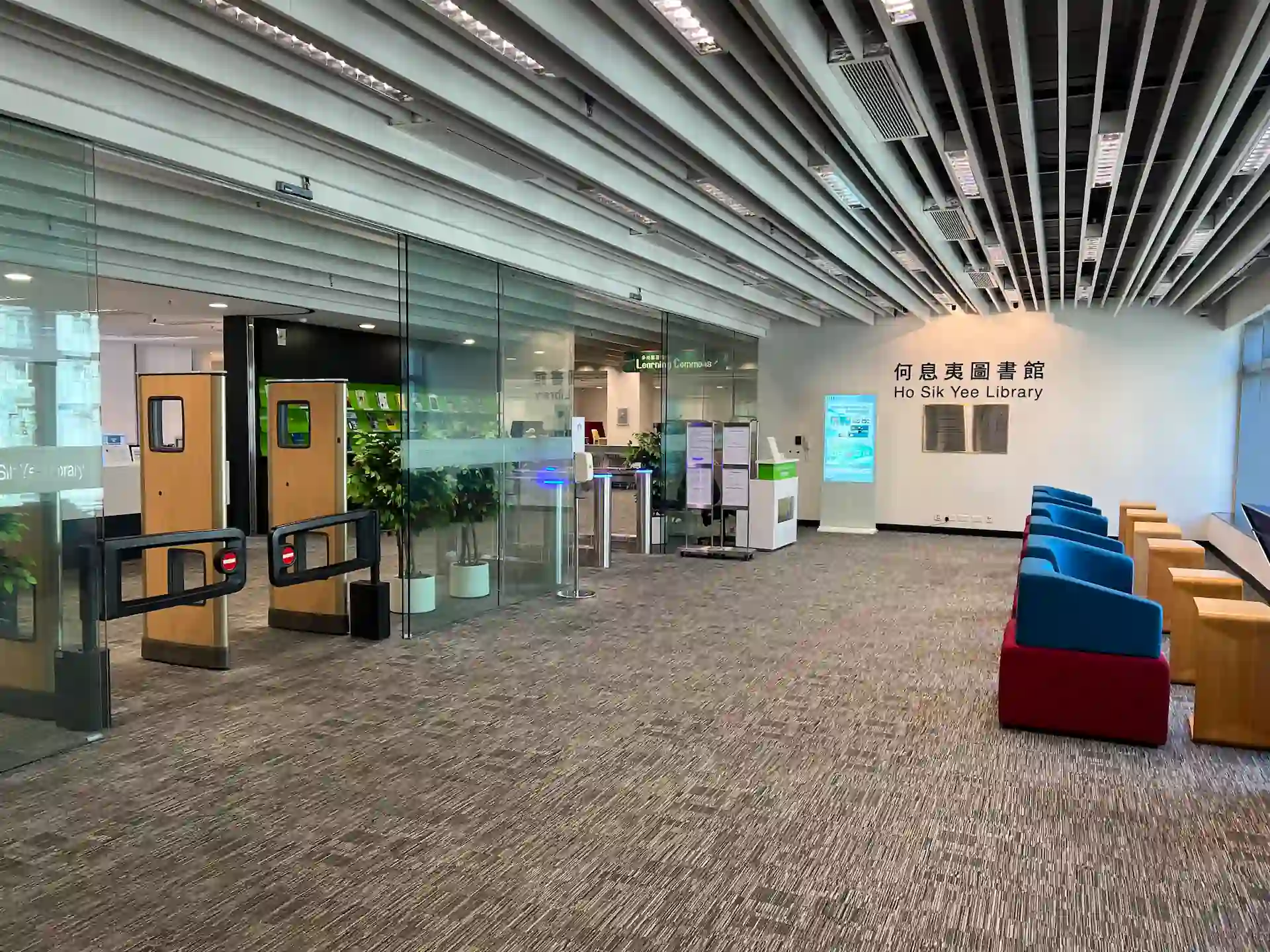
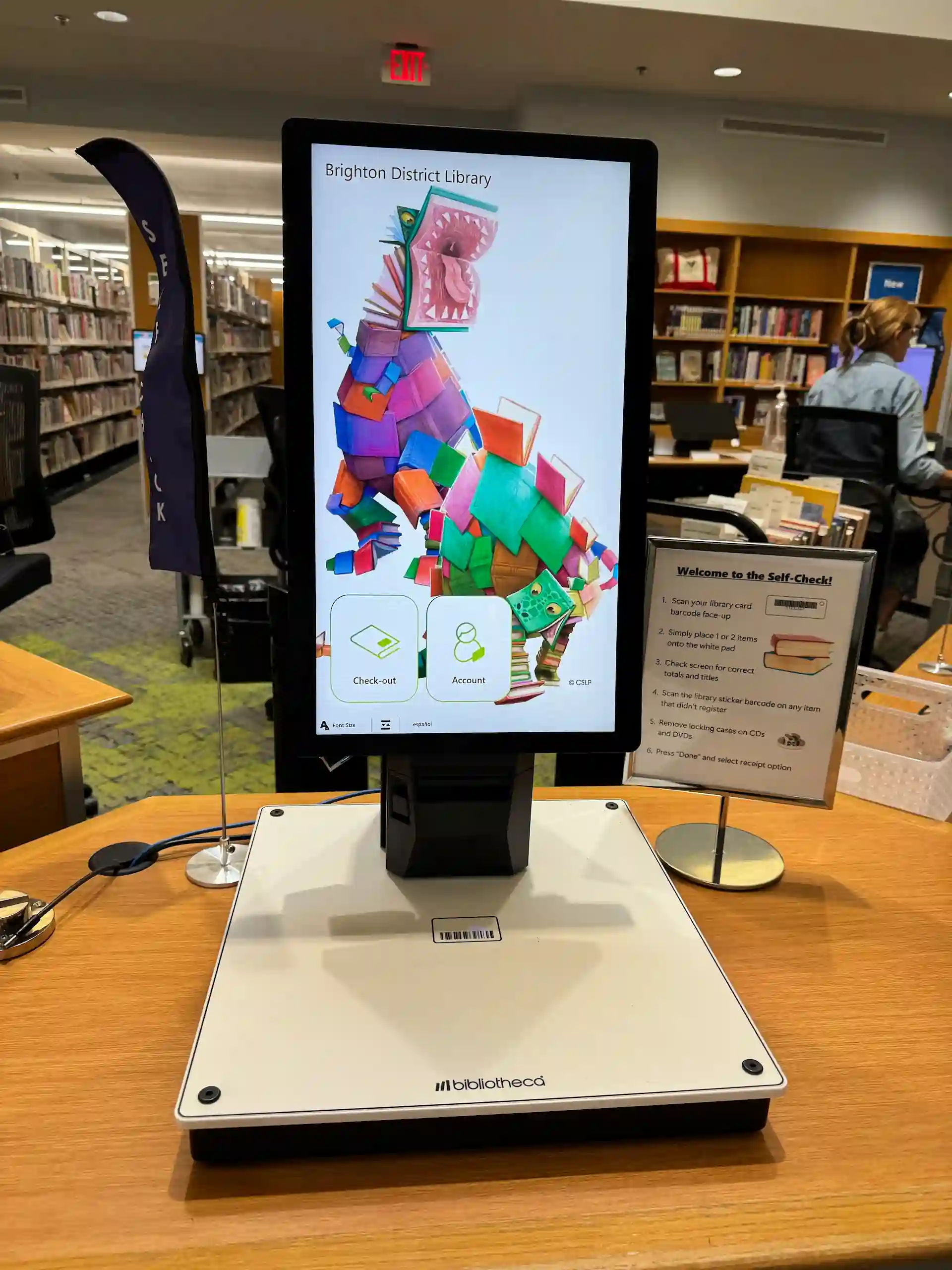
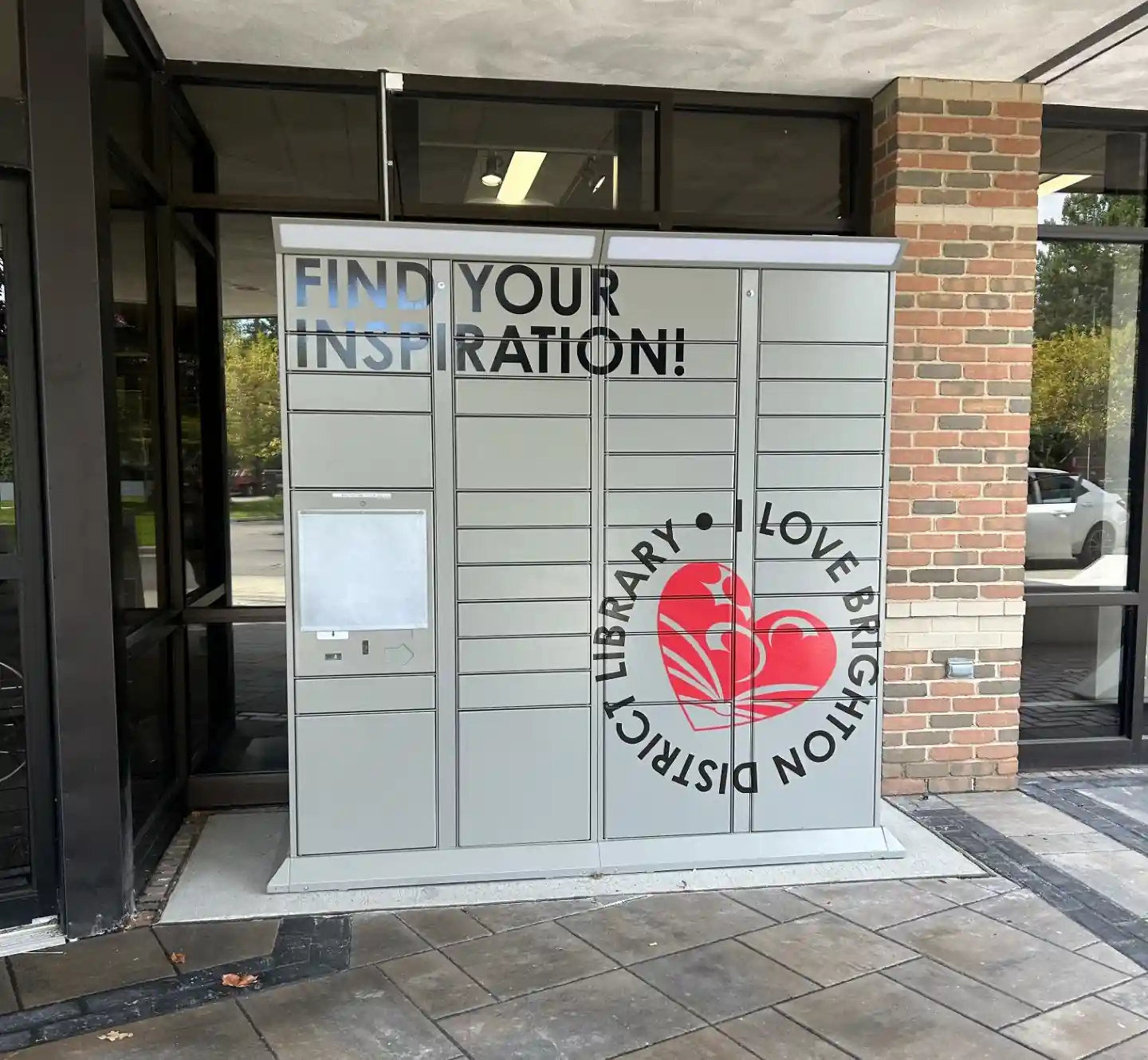

RFID supports a connected library experience, from self-service and secure access to faster returns, inventory, and more efficient use of staff time.
What to ask before choosing RFID
These questions can help your team compare RFID systems and understand what implementation will involve.
Which ISO 28560 data profile does the system use, and how portable are the tags if we change vendors?
What does the tag store, and what stays in the ILS?
Which ILS protocols does it support, and do we need additional licenses from the ILS provider?
What happens to circulation and item security if the network or ILS is unavailable?
What affects reading range and performance across different parts of the library?
What would conversion involve for a collection of our size, including tagging and materials that need different tags?
What warranties and support are included, and how long is the hardware supported?
Can you provide references from libraries of similar size, collection, or use case?
Frequently asked questions
No. A library tag holds item data: the barcode, the item type, a code identifying the home library, and a security state. Patron records stay in the ILS.
Roughly 18 to 24 in (46 to 61 cm) from a typical antenna, and 3 to 5 ft (0.9 to 1.5 m) from a large gate antenna. Reading beyond about 6 ft (1.8 m) is impractical.
With two people working from a tagging cart, at least 300 items an hour is a realistic planning figure. The project scales with the collection, and each item is tagged once.
Rewritten, yes: a replaced barcode can be written to the existing tag. Reuse is another matter, because the adhesive bonds to paper and tags are built to last the life of the item.
It can, but it does not have to be the reason to convert. RFID adds identification to the security state, which is what makes an alarm resolvable to a title.
No. Libraries commonly tag in stages and run hybrid workflows at the desk while coverage grows, changing the entrance last.
Planning an RFID project
Let us help you plan a conversion for a collection of your size, and what comes after it.

You may also Like
Insights + Trends

AI for Librarians: Where to Start and 5 Real Use Cases
The skills behind a good reference interview are the same ones that make AI useful. A library director shows how, with five projects you can borrow.
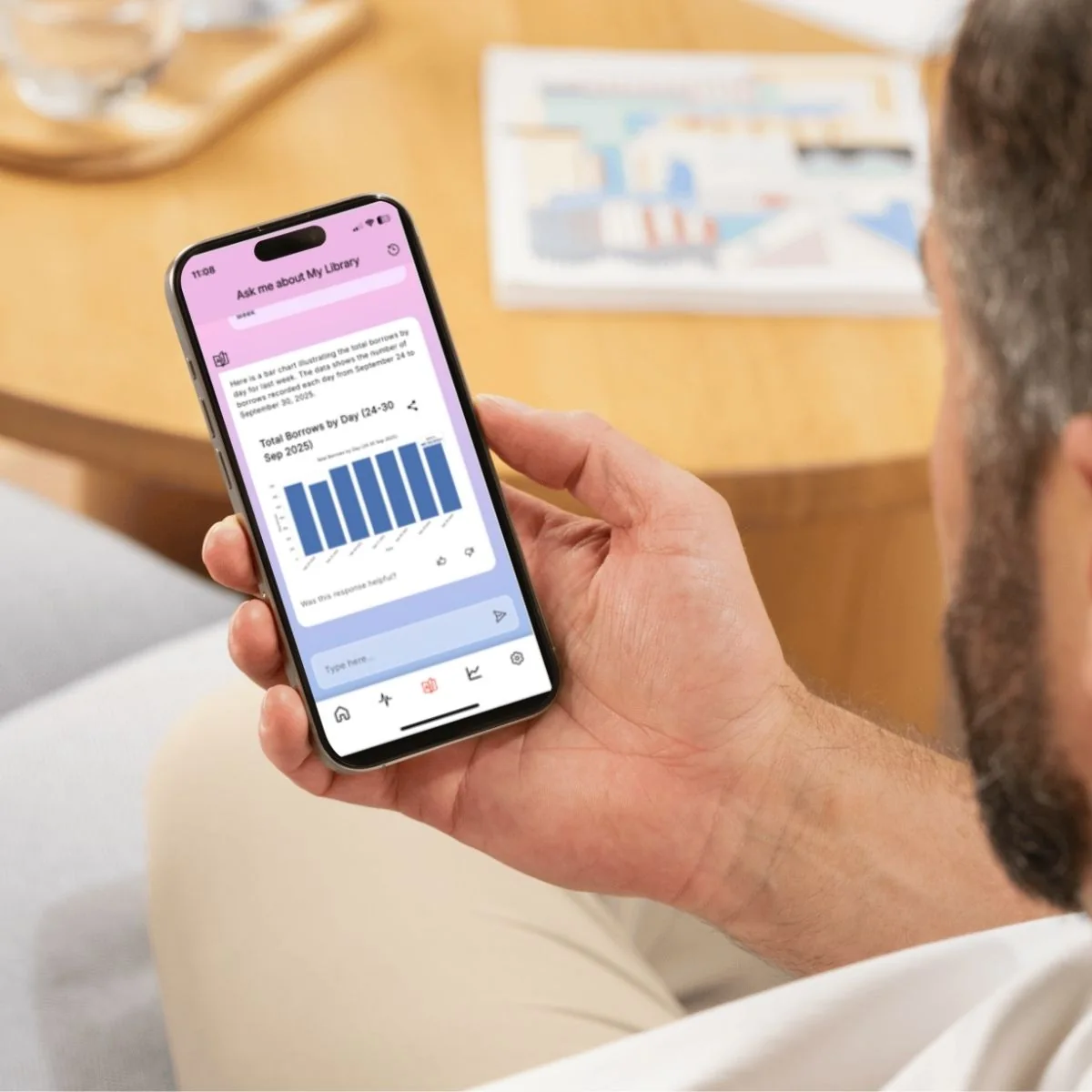
libraryConnect LINK: Managing Devices, Data and Support in One Place
See how libraryConnect LINK gives library teams a clearer way to monitor equipment, manage changes, troubleshoot issues, and use operational data.

Customer Training | Bibliotheca Academy: Unlocking the Full Potential of your Bibliotheca Products
Discover Bibliotheca Academy, our new Learning Management System designed to help library teams access training, build product knowledge, and get more from their Bibliotheca solutions.