October 15, 2025

Challenge

Solution

Result
By Lisa Stamm, MLS
Sr. Solution Consultant · Master of Library Science
“Land of 10,000 lakes.”
“Flour Milling Capital of the World.”
“Juicy Lucy.”
“Star of the North”
“I’ll bring a bar.”
“Quietest Place on Earth.”
“There is no bad weather, only bad clothing.”
Minnesota has many monikers and colloquialisms, all conveying the breadth of its people, geography, food, and yes, winter. The cities of Minneapolis and St. Paul flank opposite sides of the Mississippi River a few miles apart, hence the nickname “Twin Cities,” and contain scores of neighborhoods and districts that reflect the different cultures and traditions of its citizenry. All share a commitment to nurturing community, and the result is a vibrant metro area with an ever-expanding, unique personality in a state known for being welcoming.
With such a big personality, it’s befitting that while exploring downtown Minneapolis one will encounter a 1,200 pound cherry a mere couple of miles from a 19th century flour mill, with views to write home about from the observation deck of St. Anthony Falls. Every excursion through Minneapolis yields marvels old and new, with arts, history, and nature easily comingling with thriving commerce and modernity. Possessing countless miles of pedestrian and biking paths, along with a robust transit system connecting people to destinations in record time, Minneapolis offers residents and visitors plenty of ways to traverse and discover all it has to offer.

Photo Credit: Explore Minnesota Tourism
From music of all stripes to Monster Jam, classical theatre to professional football, Scandinavian history to a State Fair that rivals any, Minneapolis keeps people active and leaves them breathless, in a good way. Spend some time at the American Swedish Institute and behold the Turnblad Mansion, affectionately called “The Castle.” Visit First Avenue (“your downtown danceteria since 1970”) to see the venue of choice for Minneapolis-born legendary rock star Prince, and check out the “Purple Path” chronicling his life in the city.

Photo Credit: American Swedish Institute
Be surrounded by the creativity of over 1,400 artists each May during the annual open studio tour that is Art-A-Whirl®. For thirty years and counting, this event facilitated by the Northeast Minneapolis Arts Association has dazzled and inspired people of all ages and walks of life, encouraging them to get to know artists while watching them work.
Catch a fly ball at a Minnesota Twins Baseball game. Revel in the sounds of the Minnesota Orchestra. Experience some of the over 100,000 works housed in the Minneapolis Institute of Art. Become immersed in live plays evoking facets of the human experience at the Guthrie Theater. Do a little retail therapy at the Mall of America. For a reset, visit the Orfield Laboratories Quiet Chamber, honored by Guinness World Records as “The Quietest Place on Earth.”
Minneapolis is also known to conquer appetites with famous local fare that redefines comfort food. Try the “Juicy Lucy,” an iconic burger originating in Minneapolis in the 1950s, in which cheese is cooked between two hamburger patties, resulting in a molten, gooey, and, by all accounts, delicious mess of a burger. Another Minnesota original is the tater-tot hotdish, perfect for those who prefer their meat and cheese mixed with vegetables and creamy mushroom soup and baked as a hearty casserole topped with crispy tater tots.

Photo Credit: Meet Minneapolis
Purists may like their cheese deep-fried into cheese curds, with a side of blueberry ketchup or Thousand Island dressing. For a sweet tooth, try a dessert bar, known to Minnesotans simply as “bars” and encompassing flavors from lemon to peanut butter to chocolate chip to butterscotch. If not a bar, then a scoop of Jell-O salad in various flavors and filled with sundry fruits, marshmallows, nuts, and whipped cream. Whichever Minneapolis-based delicacies are on the menu, bring lots of napkins while tailgating with 70,000 others before a Minnesota Vikings game.
Of course, Minneapolis and the entire state of Minnesota bring to mind the great outdoors, namely, its thousands of lakes (the true number is well above the 10,000 of its tagline). There are 1,555 acres of parks and public land inside Minneapolis city limits, most notably five bodies of water that comprise the Chain of Lakes. From sunrise to sunset, amidst glittering water with a cityscape backdrop, people walk, run, bike, swim, water ski, canoe, kayak, boat, and venture out on paddle boards. Both novice and professional photographers traverse the banks for spectacular views, while others play volleyball, tennis, and practice archery. Still others toss a frisbee while many simply settle down on a blanket with a good book.

Photo Credit: Minneapolis Park & Recreation Board
But arguably, no one does winter better than those in the Star of the North. Consider nearly every outdoor pastime and sport done during temperate months, and you’ll find a winter version happily embraced. Embodying the Swedish phrase, “there is no bad weather, only bad clothing,” locals and visitors during winter in Minneapolis suit up and get outside for igloo dining and ice bars, along with The Great Northern festival, a 10-day outdoor celebration of winter complete with live music and film screenings, guided nature walks and crisp runs, fire pits and s’mores, and even a pop-up “Sauna Village.”
After the thaw, millions of locals and travelers alike flock to “The Great Minnesota Get-Together,” otherwise known as the Minnesota State Fair. Ranked the second largest state fair in the United States, it has delighted crowds since 1859. This great get-together regularly sees nearly two-million attendees across 322 acres during a twelve-day span and has the mind-boggling trivia to prove it.

Photo Credit: Minnesota State Fair
Speaking of attracting interest far and wide, the Cedar-Riverside neighborhood in downtown Minneapolis is home to Augsburg University, a small liberal arts university that attracts students from around the world. Since 1869, Augsburg University has followed its mission to educate students “…to be informed citizens, thoughtful stewards, critical thinkers, and responsible leaders…supported by an engaged community that is committed to intentional diversity.” With its small class sizes, attention to academic success (and reputation for producing Fulbright Scholars), plentiful clubs for students to explore and expand their interests, and prime location, it’s easy to understand the appeal of Augsburg University.

In the heart of campus is Lindell Library, named for the Lindell Family after a lifetime of philanthropic support from 1940s Augsburg student James Lindell. We’ll come back to James, and his wife, Jean, a bit later. With four floors of robust collections and services and a team of devoted librarians, Lindell Library provides Augsburg students everything they need for success in their studies and in their pursuits of educational, inspirational, and recreational camaraderie and growth.
Lindell Library recently adopted and began to implement a five-year plan in conjunction with the university’s sesquicentennial strategic plan. The library plan notes its purpose of supporting the mission of Augsburg and outlines goals such as becoming “a place where every Auggie feels at home, supported, and represented on campus and in our neighborhood,” with corresponding actions such as conducting a refresh to its spaces to create “multipurpose, neurodivergent-friendly, and flexible-use areas to support the needs of every Augsburg student.”
Sara Fillbrandt, Electronic Resources & Metadata Librarian at Lindell Library, explains, “Augsburg University is a private, liberal arts university in the heart of Minneapolis. We offer undergraduate and graduate degrees to approximately 3,200 students. We’re small, but we’re mighty. We’re a very community-based institution, and our campus surrounds Murphy Square, which is the city’s oldest park. We have a partnership with the City of Minneapolis to help them take care of the park. It’s only one square block, but it’s important to have and it’s a nice green space in the middle of campus for our students.”

“We’re situated downtown near the Mississippi River and the Seven Corners theater district, so we get all sorts of wonderful performances and we’re on a lot of public transportation lines. It’s a great location and very integrated into the community. Our students do community service events and our employees are encouraged to do sixteen hours of community service on the clock each year. Augsburg is very service-oriented, and I love that.”
Fillbrandt continues, “We serve minority populations, we serve folks who might not have the opportunity to go to school otherwise; 66% percent of our undergraduate day program are BIPOC students, 3.2% are international, and 56% of our students are first-generation college. We have people from the community who live across the street and are students here, and we have students from 36 different states and 28 other countries. Augsburg University takes the globe and shrinks it down and brings it into this small campus, so, while we’re small, we’re big. We’re focused on us, but we’re also focused on what we can do for the world around us. It’s an amazing dynamic.”
Over the decades, the library has gone through different iterations. In the beginning, the library was located in the basement of “Old Main,” the first building on campus. Some of the university departments maintained their own small library collections until 1954 when Augsburg broke ground to build a brand-new library. At the unveiling of the Sverdrup Library in August 1955, the disparate collections shifted to a centralized library model. In 1997, to meet the ever-increasing use of the library with more space, they built the James G. Lindell Family Library.


“The library has grown and moved with the times,” Fillbrandt says, “and we’ve been undergoing a lot of changes in the past year, which is exciting. As it stands today, we have over 100,000 physical titles, we subscribe to over 525,000 ebooks, and we have a large collection of DVDs, CDs, and music scores because we have music and music therapy programs on campus. We’ve got a little bit of something for everybody.”
She shared that the library moved from a “just in case” to a “just in time” collection model. They weeded items that hadn’t been borrowed in years and bolstered the collection of materials faculty use to teach students, even purchasing, when possible, textbooks to help students save money. They work with faculty to embed ebook links directly into course syllabi for student access, and they fulfill student and faculty requests for materials specific to their areas of study.
Lindell Library also recently joined the MnPals Consortium, which consists of over fifty libraries throughout the State of Minnesota and which facilitates resource sharing among members for discovery of and access to books, articles, digital assets, and other resources. As part of joining the consortium, the library migrated its entire catalog to a different library services platform.
“The migration was an opportunity for us to look at how we were currently doing things and ask, why are we doing it this way?” Fillbrandt says. “It was good to go through all of the workflows and all of the processes and say, we’ve been doing it this way because we’ve always done it this way, and we can let that go now. We can simplify things, and we can make things more accessible and easier to find.”
When migrating from one library services platform to another, they found that “…it worked very similarly, but not exactly” in the same ways with their cloudCheck tablet and remoteLocker, so Fillbrandt reached out to Bibliotheca support while also working with the new platform provider, to sort things out together.
“I sent a lot of screenshots,” she smiles, “to one of the really, really nice Bibliotheca support guys. He was great. He asked, have you tried this? Can you do this? Can you send me this? And then, because I’m in the middle, I was also talking to the platform provider and saying, okay, your product is doing this, and Bibliotheca is saying this, and now what do I do? There was a lot of back and forth, but support at Bibliotheca was always really responsive.”


Library staff tackled other projects at the same time as migrating the catalog, such as refreshing the physical spaces to introduce more color, with new furniture to encourage gathering, and a board game collection that students can borrow or play while inside the library.
“All of that has been such a positive change for our library, and we are seeing so many more students coming in and engaging with us and with our spaces, now that we’re not the place where you have to be quiet,” Fillbrandt says. “We do have a quiet floor on the library, but otherwise, come in and talk and meet with your friends, and laugh, and do research for fun or for academics, or play a game, or work on the community puzzle. Just be here and use the library however you need to. It’s the students’ space. It’s not our space as the librarians, we just curate it; it’s their space.”
“We’ve got sensory-friendly areas in the library, now, along with our ten study rooms on the third floor,” she continues. “We have meeting spaces and all of our IT folks have moved into the building, and we’re working on turning the library into the information center on campus. You can come in and ask somebody at the service desk if you need IT help. The research support desk is right there, too, so if you have a research question, a librarian is there. If students need academic advising, those folks are on the second floor of the library. Disability specialist offices are on the second floor, along with our TRIO support team, all in the same building.”
“You come to one spot and you get the help you need right there, and I love that about our library. Instead of having students go all over to different places on campus, everything is centralized in the library building itself. For the most part, you go to one place and you can pretty much guarantee to get your question answered.”

As promised earlier, we now return to library benefactors James and Jean Lindell.
In mid-2024, the university offered staff and faculty an early retirement package, and three librarians, including the library director, took it. “All of a sudden, we found ourselves down to a staff of four,” Fillbrandt shares. “Our associate library director was promoted to library director, and he’s doing a fantastic job. And we realized that we were spending a lot of time at the circulation desk, because our circulation librarian took the retirement offer. She had been our frontline person and she managed a whole bunch of student workers.”
The library team soon realized that they were spending a lot of time doing repetitive tasks. “Once we got down to a team of four, our new director said, we can’t continue the way that we’ve been doing things, and we need to find a new way of helping students. We can’t have specialist librarians sitting and waiting to check out books, that’s not the best use of time.”
“He was adamant that we were going to move to a self-service model, that we were going to give it a go,” says Fillbrandt. “The idea was, students would see that it’s a lot like a grocery store: you can pick up your own things, you can check yourself out, and you can go. No one’s looking over your shoulder, there’s no perceived judgment based on what you’re checking out, no one’s questioning anything.”
“In addition,” she continues, “we needed to update the way we were doing reserves for faculty. We had faculty members who put books on reserve, but it would be a recommended read, not required for the course, and often, books would sit and not be checked out. We would have books sitting there, not being used because they were on reserve for faculty, and it didn’t work well.”

Lindell Library team from left: Sara Fillbrandt, Karen Hogan, Tanya Gunkel, Stewart Van Cleve, Megan Schierenbeck, Kristine Kammueller, Kira Cronin-Hennessy
They decided that they needed a way for faculty to be able to place books and materials on reserve with a finite reservation period, whether a couple of days or a week, and to have an avenue in which students could independently borrow and return those materials.
“That was the impetus for doing the locker system: we needed something that was going to help with course reserves and that was located in a spot where, if students requested something from the collection, we could put it in one of the lockers and they could pick it up whenever they wanted to. They didn’t have to come to the desk during a certain time when we were sitting there. Basically, divorcing the service function of circulation from when actual people are there. Divorcing service hours from the building hours. Even if no one was at the desk, students could still check out books, pick up holds, pick up interlibrary loans, or they could return something. They’re not tied to staff having to be there to help them do that.”
Library staff were on board with the plan for the remoteLocker. They discussed how to promote it and thought of pairing it with their cloudCheck tablet, and someone suggested naming each after James and Jean Lindell.
“We were in a joint staff meeting with our IT department, who were instrumental collaborators from the get-go, and somebody said, are we going to call the selfcheckout and the lockers something?” Fillbrandt explains. “We needed vernacular that people would be able to grab onto.”
Since there were regular lockers all around campus, somebody suggested that, because they were the Lindell Library, they should name the selfcheckout machine “James.” Taken with the idea, library staff furthered it by deciding that the remoteLocker would be named “Jean,” and that’s how they would differentiate between the two.
“When students are going to pick up books, they pick them up with Jean, and when they’re checking out, they check out with James.”

“We got our marketing department involved, and they created signage and wraps to help visually bring James and Jean out, to make them noticeable and easy points to find,” Fillbrandt says. “They do pop, they’re beautiful. Marketing did a fabulous job, because before we had James and Jean, it was a very beige library, not exciting at all. But since we’ve gotten them, and since weeding the collection, and refreshing the spaces, and moving to a just-in-time model, we have seen a big uptick in students coming and spending time in the library, which is phenomenal and what we wanted.”
She says that students love James and Jean, and that they often mistake Jean for online retail pick-up lockers and are excited to learn that they’re for books and other library materials. Library staff explain the similarities and students are immediately pleased because they find them familiar and easy to use. Students frequently comment on the remoteLocker. “They say, this is a brand new thing, I’ve never seen a locker like this in an academic library, can you tell me more about this?”
With James and Jean in place, library circulation has increased by 5% each year and self-service is at 98%. Library staff spend far less time on repetitive tasks and have far more time to be available to students, and students take advantage of that. “If students want to talk to a person,” Fillbrandt says, “a person is right there for them.”

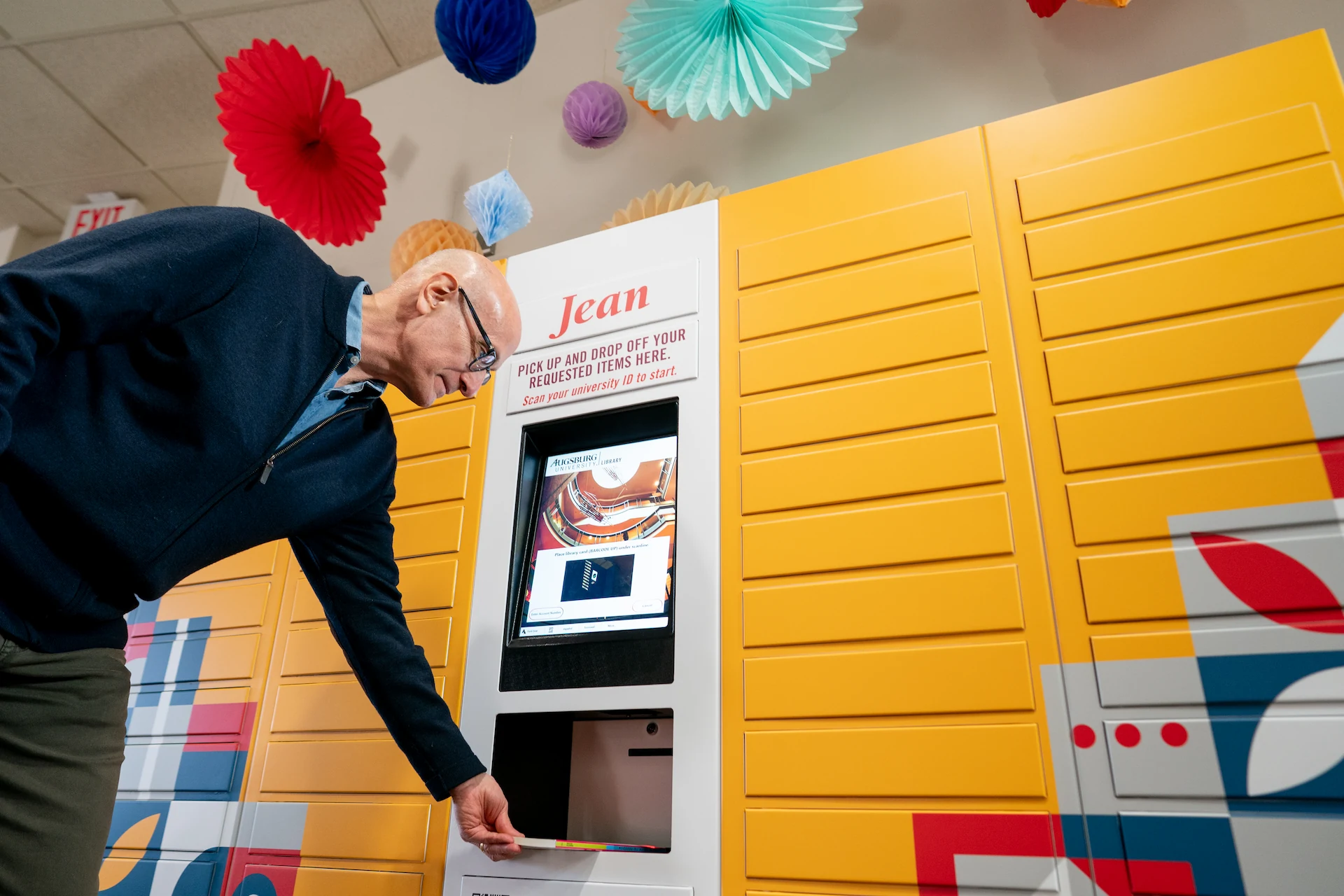
Students particularly appreciate the wide array of languages available to them while using the cloudCheck tablet and remoteLocker. “With the diversity of our student population,” Fillbrandt says, “having the ability for them to switch languages on James and Jean has been fantastic. We have a large Somali population, and Hmong population, and our students also speak French, Spanish, Japanese, Korean, and Arabic.”
“They love being able to use the machines in their own language,” she adds, “and it’s fun to see their faces light up when they see that they can interact in their native tongue. If English is their second, third, or even fourth language, they don’t have to default to English. And people love that it saves their preferences, that as soon as they scan their barcode on their library card, it just automatically pops back up in the language that they’ve asked it to remember.”
“It’s meeting people where they are. Accessibility is one of the things that I’m most passionate about, and making things easier for people to get to. I am all about fewer clicks to get to a resource. I am all about making sure that folks can get access to a dyslexic-friendly font, or something that is screen-reader-friendly, or that works with whatever their particular colorblindness is. My joy is being able to help with that, and so the ability to have things be more accessible because of a language translator, so there’s not a language barrier, is absolutely huge.”


In considering advice she would give other libraries exploring the idea of using remoteLocker, Fillbrandt says she would tell them “…to make sure that they work with other departments on campus first, before they decide to jump in. Make sure that IT has the availability and the time to help work on a project. Our lockers needed to be anchored to the wall, so we had to get facilities involved, and they needed to run cables and install a new electrical outlet.”
“Be sure that any and all stakeholders that may be affected by a project like this are involved from the get-go, because it’s important to have everybody on board and to have buy-in from the vast majority. Look into it, see if this would be a benefit for your community, poll your community and find out if they’d be interested in such a thing. If it’s a good fit for your space and your needs, I would tell them that the lockers have been a game changer. They’ve been absolutely helpful and I can’t imagine going back.”
Fillbrandt commends Lindell Library Director Stewart Van Cleve for his vision to implement a self-service model, and for bringing the right people on board to execute it. She also lauds provost Dr. Paula O’Loughlin for being receptive to the changes being made in Lindell Library, and for helping to get messaging out to faculty and to the community at large.
“I’m very happy to be part of a community that is willing to try something new. This has turned out to be a wonderful thing for the library, the students and faculty, and the community at large. I love the team that we have at Lindell Library, and I’m excited to see where we go from here.”
Spread the Word

You may also Like
Insights & Trends

Customer Training: Hot Topics in quickConnect and System Manager
AI for Librarians: Where to Start and 5 Real Use Cases